QPM vs Kantata: A System of Record for the CFO or a Production Tool for the Producer

Kantata is a recognized leader: IDC MarketScape named it a Leader in AI-enabled PSA for 2025–2026, and G2 included it in the 2026 Best Software Awards. If you've seen it on a shortlist – that's deserved.
But there's a nuance with leadership reports: they're read by finance directors, while deadlines are held by producers and team leads. And this comparison is about a difference not in quality, but in purpose. Kantata was built as a system of record for the person who counts a services business's money. QPM – as a production tool for the person accountable for the date.
Let's break down honestly where that difference becomes decisive.
What Kantata Actually Is – and Why It's Strong
Kantata grew out of the merger of Mavenlink and Kimble and is fully focused on professional services. There are two products: Kantata OX – a standalone PSA for midmarket and enterprise, scaling from hundreds to thousands of users, and Kantata SX – a Salesforce-native PSA for complex, multi-entity global organizations.
Financial depth is the main trump card: revenue recognition, multi-currency consolidation, complex WIP accounting – if you're a 500-person global systems integrator on Salesforce or NetSuite, this is exactly the level of governance you need.
And – importantly, for the honesty of this comparison – Kantata's resource optimization has a serious pedigree. Its tool uses multi-variate algorithms and operations science to optimize staffing plans across roughly two dozen parameters – the roots of the 2021 Mavenlink Optimizer. The new Resourcing Agent and Expertise Engine, built on a proprietary Services Language Model, add an AI layer: scoping, pricing, team assembly, risk prediction. Proactive over-allocation detection catches problems before they happen.
So no, Kantata is not "yet another AI assistant on top of boards." This is mature engineering. The question is different: what exactly it optimizes, and for whom.
Weight Class: What "Buying Kantata" Actually Means
Before talking features – a conversation about implementation reality, because half the decision hides here.
Implementation timeline. A standard Kantata deployment takes 3–4 months. There's a Quick Start for the resource module in ~4 weeks, but a full PSA rollout is a quarter of project work with consultants.
Price and threshold. There's no pricing on the site – only "contact sales." The platform pays off at the scale of 100+ billable consultants and $10M+ in annual services revenue. For a 10-person team, that's an enterprise price for features you'll use a fraction of, and the onboarding cost in time alone will sting.
Life after launch. The UI is "clicks-heavy," which often leads to adoption collapse among consultants unless the system is run by a dedicated administrator. In other words, the budget includes not just the license, but a person who keeps the system alive.
For an enterprise, that's a normal price for governance. For a studio or IT company of 30–200 people, it's a quarter of time and budget that could go into production instead.
The Key Difference: Staffing Optimization ≠ Delivery Calculation
Now the main point. Kantata's algorithms answer a portfolio-level question: "which of our consultants should go on which project so that utilization and margin are optimal." That's the job of a finance and operations director, and Kantata solves it better than most.
QPM answers a production-level question: "when will this specific project's iteration be ready – and what will delay it." That's the producer's job, and it requires a different mechanism:
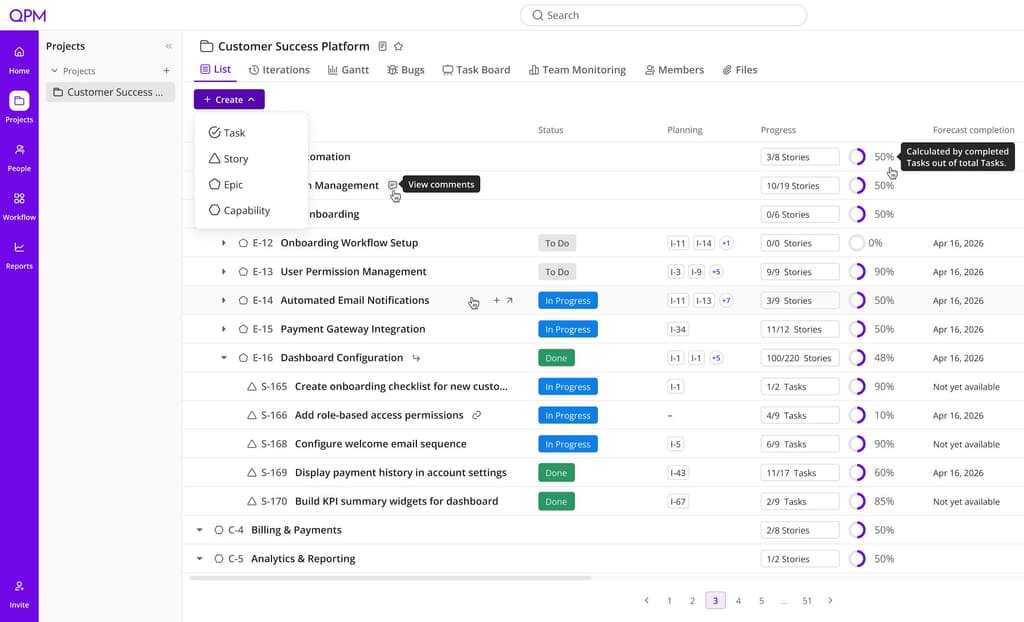
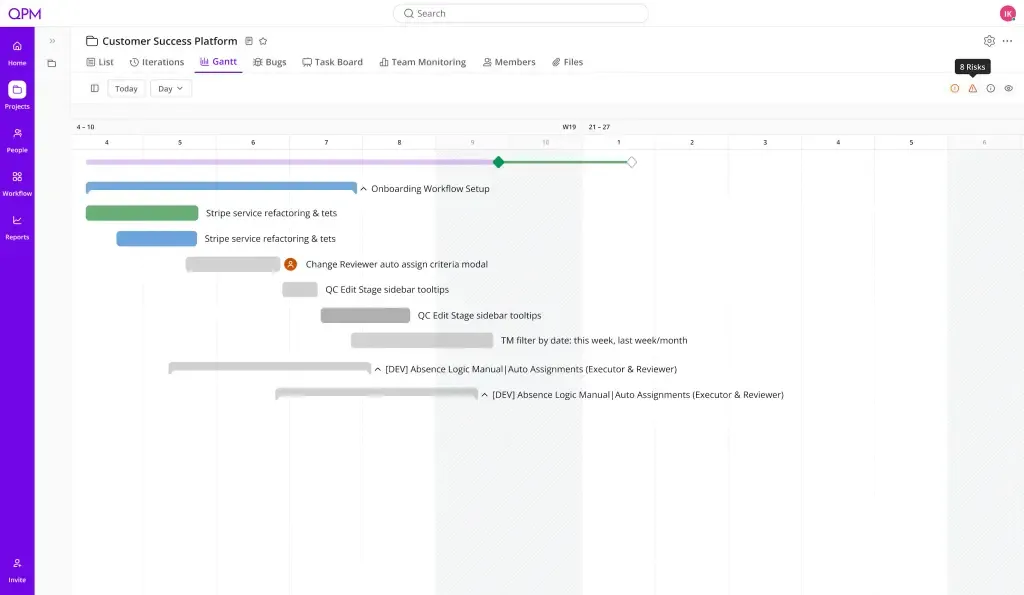
The task as the unit of calculation. Not a person's allocation to a project, but a specific task with an estimate, dependencies, and required skills – and a calculated iteration completion date with an explanation of the bottlenecks.
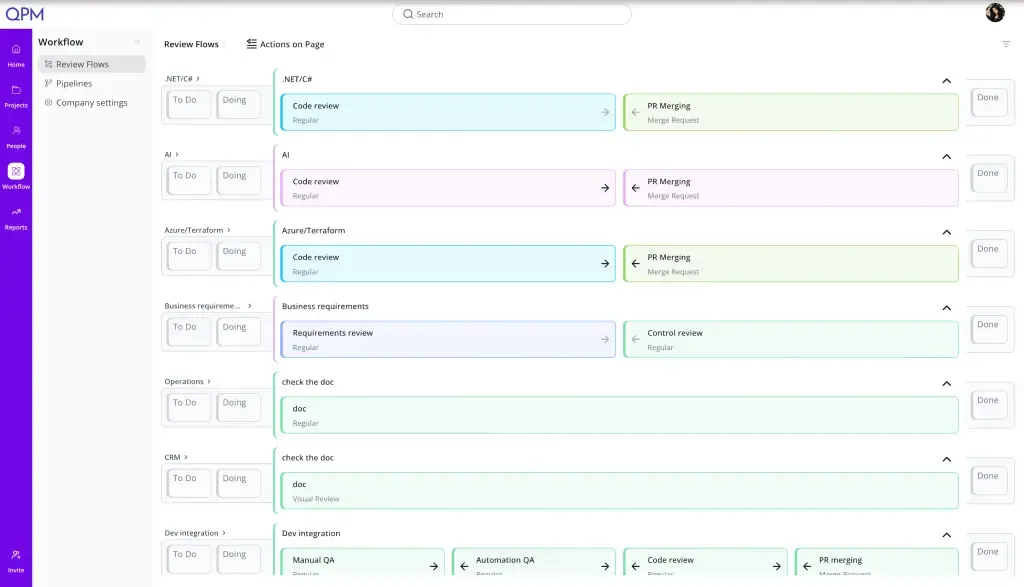
Review Flow in the date calculation. Multi-stage review – code, art, builds, documents – where each stage has an assignee by role or qualification and its own duration, and all of it is built into the date from the start. In the PSA model, review is just hours in utilization.
Staffing gaps at the planning stage. A task requires a skill nobody has; the reviewer needs to be one level higher and no one at that level exists; there's one person on a track with no reviewer – QPM shows this before the start, turning planning into a team audit.
Buffer Time Planning. A buffer only on the critical path, where it actually protects the deadline – a shorter timeline at the same reliability, one you can confidently name to a client.
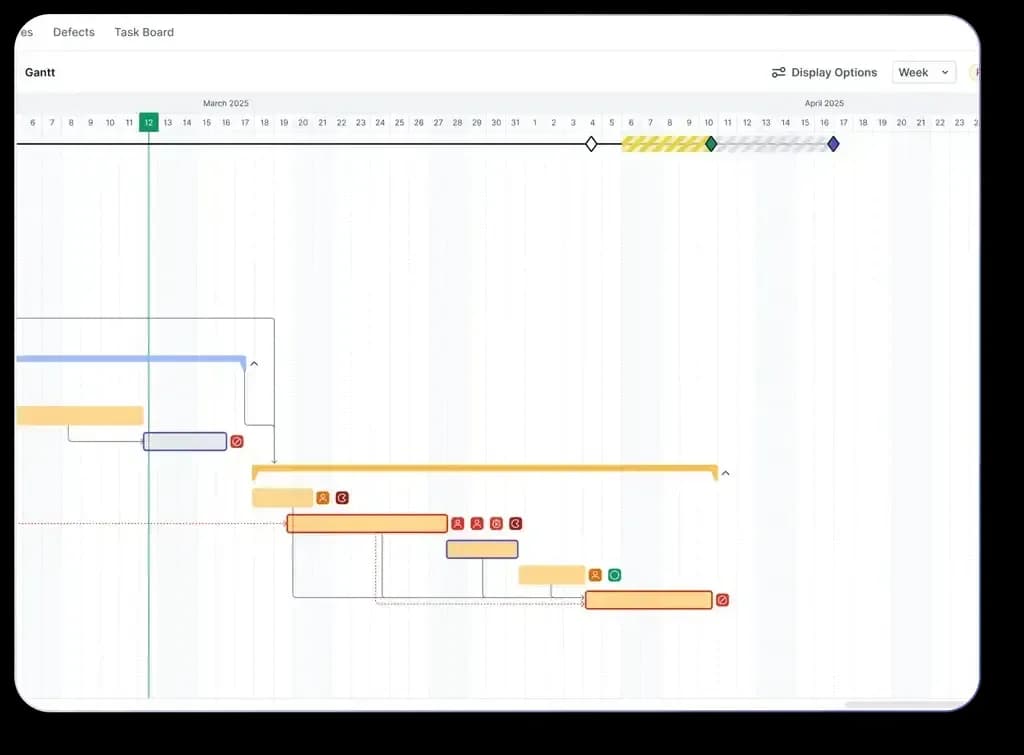
Auto-replanning. Sick leave, a new task, a shifted estimate – the plan and dates recalculate instantly, no administrator required.
And all of this with 3–5 days of onboarding, not 3–4 months.
QPM vs Kantata: Direct Comparison
How to Choose
Kantata is the right choice if you're a services organization with hundreds of billable consultants, multi-currency operations, complex revenue recognition, and Salesforce at the center of your stack. At that scale, its financial governance and portfolio optimization pay for both the quarter-long implementation and the dedicated admin. It's a CFO-level decision – and at its level, it's a deserved leader.
QPM is the right choice if you're a studio or IT company of 20–200 people, where the main question isn't "what's our portfolio utilization" but "when will this project be ready, and is the date in the contract realistic." Game studios with art and QA, product teams with complex review, outsourcing shops with hard deadlines – what's needed here is a tool the team actually works in every day, not a system of record filled in for reporting.
In short: Kantata optimizes a services company's business. QPM calculates a specific project's delivery.
You've compared — now test it on your own team
Leave your email and we'll show you the difference not in a table, but on your real iteration: with your people, skills, and deadlines.