QPM vs Linear: "Issue Tracking Is Dead," Said Linear's CEO. We Agree. Our Conclusions Differ

In March 2026, something rare happened: a competitor articulated our point better than we ever did. Introducing their AI agent, Linear CEO and co-founder Karri Saarinen declared: "issue tracking is dead."
He's right. Task tracking – recording what needs to be done and who's doing it – has stopped being valuable in itself. The only question is what replaces it. And here, Linear and QPM give two fundamentally different answers.
Linear's answer: accelerate execution. Agents that create issues from discussions, write code, and answer questions about the codebase. Work should move faster.
QPM's answer: make delivery calculable. A deterministic algorithm that tells you when the work will be done – accounting for people, skills, reviews, and dependencies. Work should be predictable.
This isn't about "who's better." These are two different futures. Let's examine both honestly.
What Linear Built in 2026 – and It's Impressive
Credit where it's due: Linear didn't bolt a chatbot onto a tracker – it's rebuilding the workspace itself around agents. Linear Agent works in the web, mobile, and desktop apps, and as a plug-in for Slack, Teams, and Zendesk – you can write "create issues from this discussion and assign them to me," and it will. The Agent supports Skills – saved workflows for common operations – and Automations, which trigger automatically when issues are created.
And it goes further. Since May 2026, the Agent can read your codebase and answer questions straight from the source, while Diffs brings code review inside Linear, so the review lives alongside all your product context. The platform is being built to work with third-party AI agents like Cursor or Devin, which can be assigned technical tasks right from a Linear issue.
Linear's logic is honest: as execution accelerates, the bottleneck shifts toward judgment – deciding exactly what to build and where your team's time, attention, and tokens are best spent.
For an engineering team already experimenting with coding agents, this is the most consistent bet on the market.
Three Questions Linear Doesn't Answer – Deliberately
Linear's philosophy hasn't changed since "The Linear Method": do one thing and do it perfectly. So three things are missing not by oversight, but by principle. Yet the agent era makes each of them sharper, not softer.
"When will this be done?"
Linear accelerates execution but doesn't calculate timelines. A date in Linear is something you set by hand, and a cycle shows what got done. The paradox of the agent era: the faster agents close coding tasks, the more obvious it becomes that the deadline is held not by them – but by people. Art, review, QA, cross-disciplinary dependencies. An agent writes code in minutes – but who reviews it, merges it, tests it, and designs the interface for it, and when?
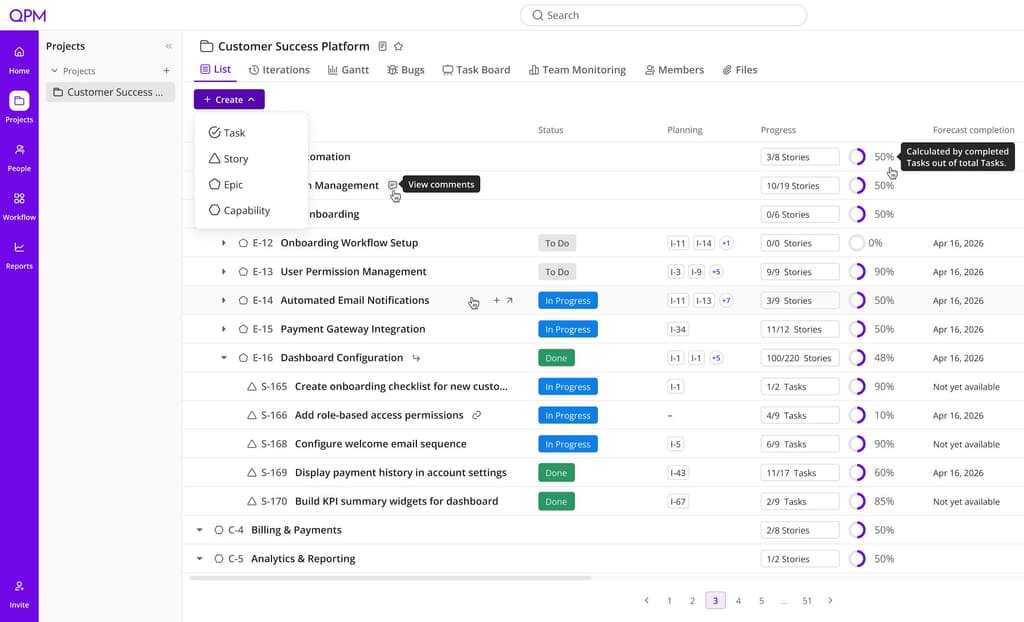
QPM calculates exactly that: connect tasks to an iteration – and get a completion date that accounts for skills, availability, all Review Flow stages, and buffers on the critical path. With an explanation of where the bottleneck is.
"Which of our 60 people should do this?"
Product Intelligence in Linear suggests an assignee for a new issue based on who fixed similar ones before. For a homogeneous engineering team, that's enough. But in a team with seniority levels, specializations, and cross-disciplinary roles, "who did something similar" is not the same as "who's optimal right now."
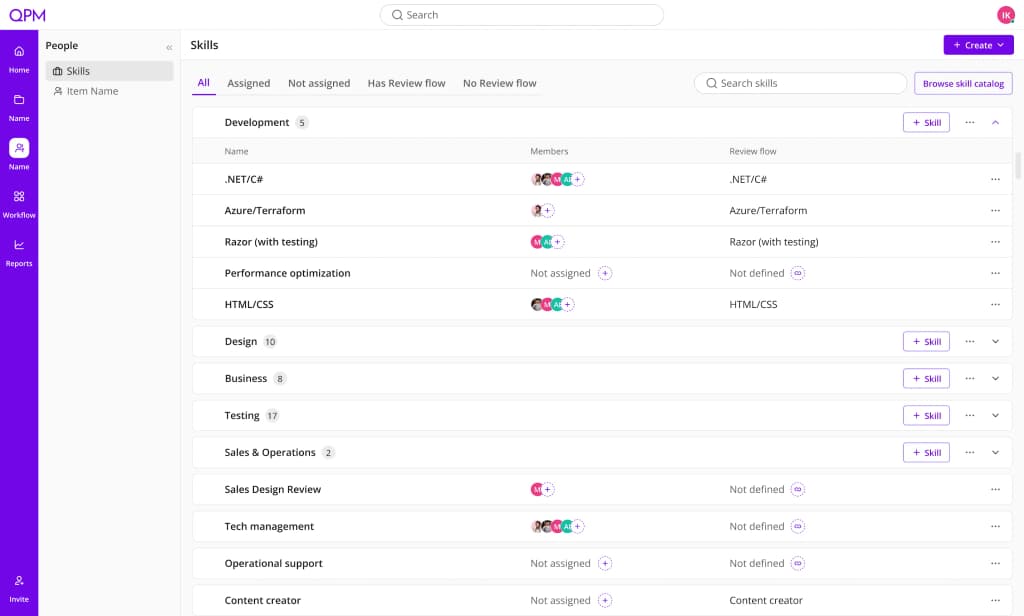
In QPM, the skill graph is computational logic: assignment by skills, level, and current workload, with the choice explained. And with staffing gaps flagged before the start: a task requires a skill nobody has; the reviewer needs to be one level higher and no one at that level exists; there's one person on a track and no possible reviewer.
"What about the rest of the company?"
Linear is engineering-first by design: it's a poor fit as an org-wide tool for marketing, design, operations, or legal, and it has no built-in documentation on the level of Confluence or Notion. An artist, animator, game designer, or marketer in Linear is a guest in someone else's house. And Diffs and Code Intelligence, which strengthen Linear's review story, work only for code: review of art, builds, documents, or marketing materials doesn't exist in this model.
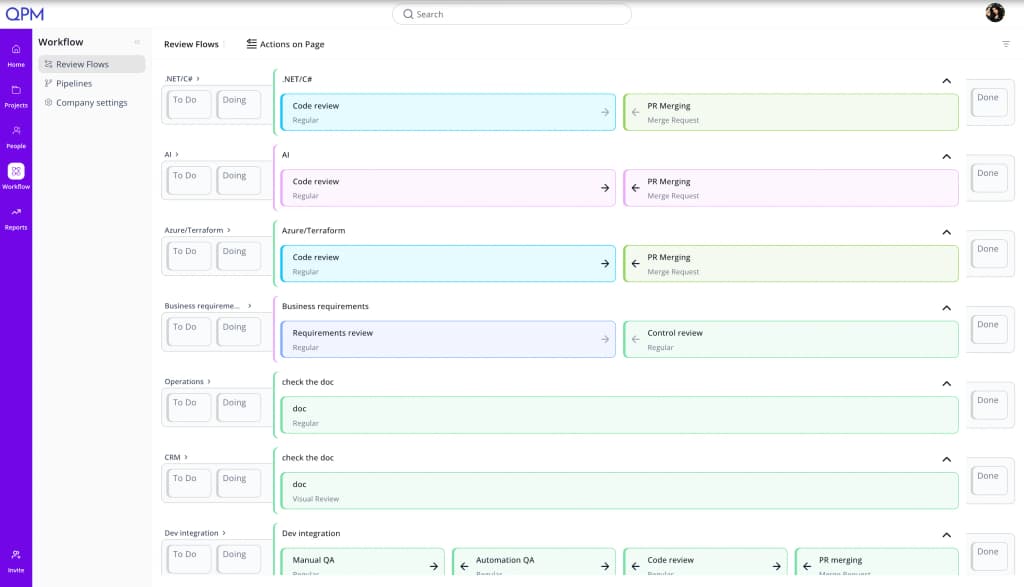
In QPM, Review Flow is a universal mechanism: multi-stage review with assignees by role or qualification and a duration for each stage works the same way for code, art, QA, and any other deliverable – and feeds into the date calculation.
What QPM Does Differently – in Brief
Auto-planning with recalculation. A change to the inputs – sick leave, a new task, a shifted estimate – instantly rebuilds the plan and iteration dates.
Skill graph. Assignment by the skills and level of specific people, not by similarity to past tasks. Plus a staffing gap audit at the planning stage.
Review Flow in the date calculation. For any type of work, not just code.
Buffer Time Planning. Buffers only on the critical path – a shorter deadline at the same reliability.
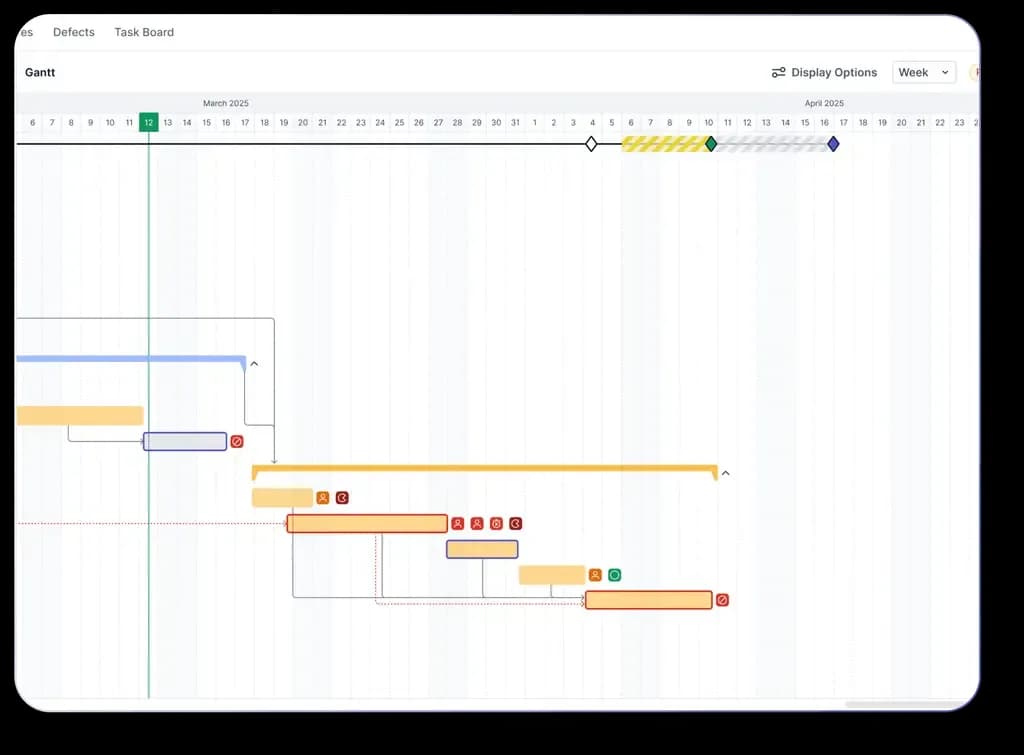
Gantt with Simulation mode. A workload check for the iteration before it starts.
Native multi-project planning. Several titles, a DLC, and a prototype – in one space, with a shared pool of people.
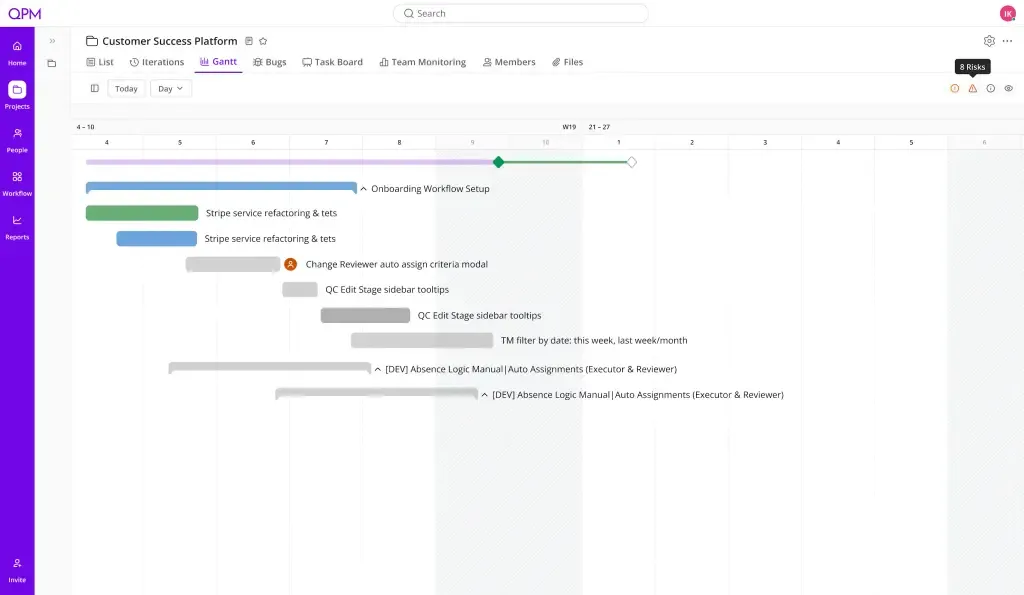
QPM vs Linear: Direct Comparison
Linear is the right choice if you're an engineering team building one product, already working with coding agents, and you want a workspace built for that future. Execution speed, the best UX on the market, the most consistent agent strategy – Linear is unmatched here.
QPM is the right choice if your team is broader than engineering, you have more than one project, and your deadline demands a calculation, not just speed. Game studios with art and QA, product companies with several workstreams, outsourcing shops with contractual dates – what's needed here isn't agent execution, but calculated delivery.
In short: Linear makes execution faster. QPM makes delivery calculable.
This Is Actually the Best Pairing in Our Entire Comparison Series
And here's the interesting part: of all the tools we've compared QPM against, Linear is the most natural partner, not a competitor. Engineers live in Linear with agents and Diffs – while the producer plans the entire production in QPM: timelines, skills, art and QA reviews, the multi-project picture. Two tools, each of which deliberately doesn't do the other's job.
"Issue tracking is dead" – yes. But its legacy was split between two heirs: Linear took the speed, QPM took the predictability.
You've compared — now test it on your own team
Leave your email and we'll show you the difference not in a table, but on your real iteration: with your people, skills, and deadlines.