Pipelines
Standardize processes and scale execution
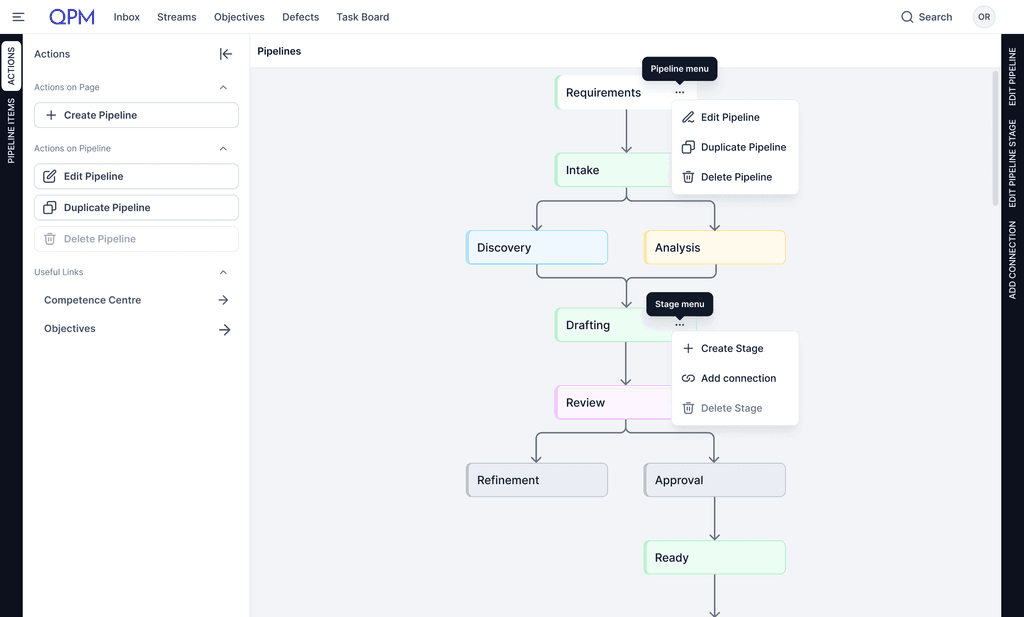
Pipelines in QPM allow you to create templates for typical workflows with defined stages, required competencies, effort estimates, and dependencies.
Apply a Pipeline to an Objective, and the system will automatically generate the full set of tasks with the correct execution logic.
No manual decomposition. No lost dependencies. No repeated configuration.



Who can benefit from the Pipelines feature?

Product Managers
For the systematic launch of recurring initiatives.
Pipelines allow you to create a unified workflow template — for example, for developing a new feature or preparing a release — and apply it to each new Objective without having to repeat the decomposition.
This ensures a consistent execution structure across all releases.

Project Managers and Project Leaders
For fast and structured team planning.
Instead of manually creating tasks, managers apply a Pipeline, which provides a complete set of stages with defined competencies, effort estimates, and dependencies.
This reduces planning time and minimizes the risk of missing critical steps.

Team leads
For controlling execution logic and team workload.
Pipelines define the correct sequence of stages and required user skills, enabling work distribution based on competencies and preventing chaotic task decomposition.

CTOs and Technical Directors
For standardizing technology workflows.
Pipelines allow you to establish the correct development structure — with dependencies and estimates — and scale it across teams without compromising quality or manageability.
Managers Responsible for Team Planning
For reusing typical task sequences.
A configured Pipeline can be repeatedly applied to similar Objectives, preserving process logic and reducing operational planning overhead.
Core capabilities of Pipelines
Pipelines enable the creation of standardized templates for recurring workflows with defined stages, required competencies, effort estimates, and execution logic.
Learn more about QPM

How Pipelines Work
The process begins by creating a Pipeline template that defines the execution sequence. For each stage, the name, required competencies, effort estimates, and dependency logic (sequential or parallel) are configured.
Why Pipelines are useful

Faster Planning of Recurring Workflows

Standardized Process Execution

Preserved Execution Logic

Reduced Managerial Overhead

Scalable Workflow Models
Learn more about QPM