The AI Coordination Paradox: The More Automation, the More Meetings

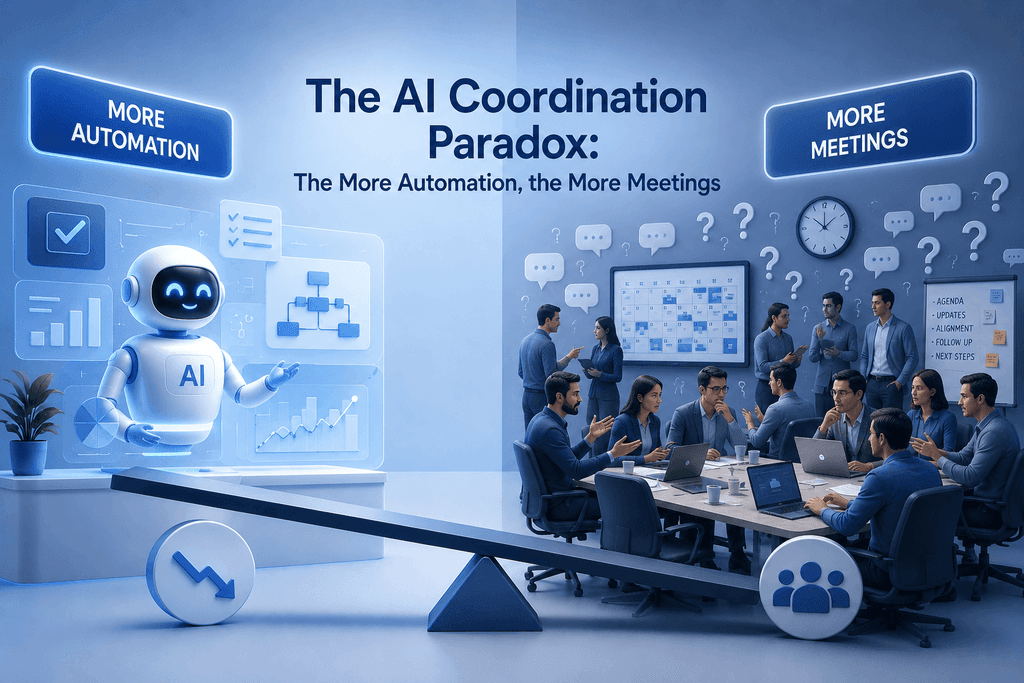
In July 2026, the Helsinki research firm In Parallel published a number that should have stopped half the marketing campaigns in the productivity market. Surveying 247 managers across five countries, the researchers compared daily AI users with people who don't use it at all.
Daily AI users spend 20.3 hours a week on coordination. Non-users spend 9.1.
Twice as much. Not less — more. And this at a time when 86% of respondents have already brought AI into their work, and the industry has spent two years running promising that coordination is exactly what AI will take off our hands first.
This isn't a measurement error. It's a symptom that we misunderstood the problem itself.
The promise
The logic behind every AI assistant for work is simple: managers are drowning in routine — reports, statuses, emails, meeting notes. Give them a tool that writes all of it faster, and you free up time for "real work."
The grounds for that logic are solid. McKinsey surveyed 706 middle managers and found that less than a quarter of their working time goes to actually managing people. Asana has documented for years that roughly 60% of the workday is eaten by "work about work." The In Parallel study adds one more detail: coordination takes up 41% of a manager's week, but managers themselves estimate it at 21%. We underestimate our own coordination load by half.
So the diagnosis is right. The mistake is in the prescription.
What went wrong
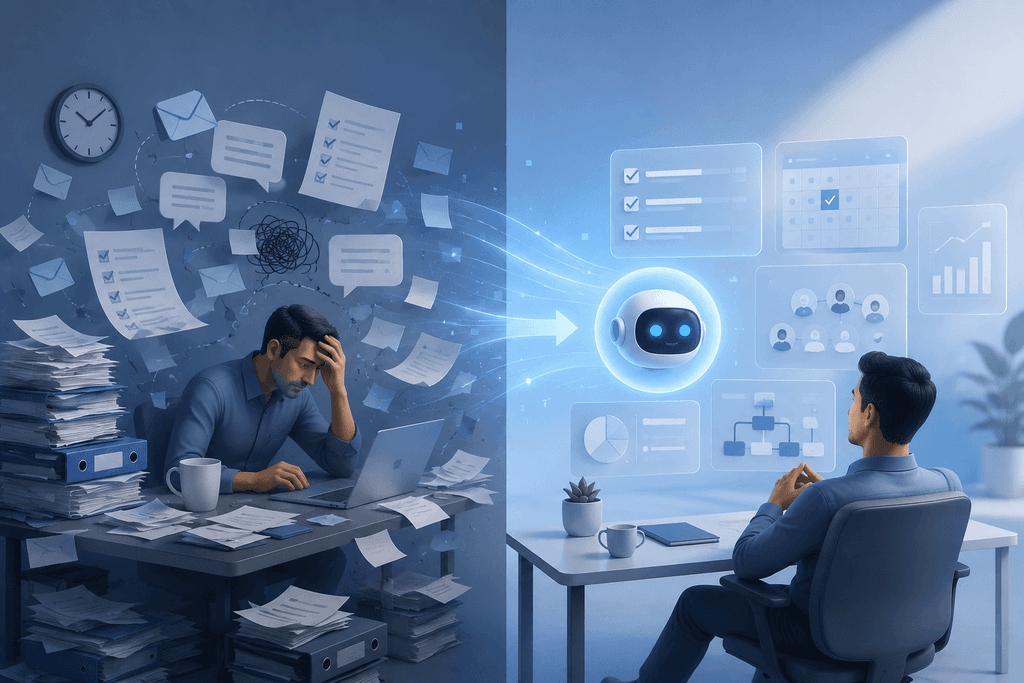
AI made producing text radically cheaper. A status update that took half an hour now takes a minute. A draft plan, two. Meeting notes, automatic.
And here the effect economists know as the Jevons paradox kicks in: when a resource gets cheaper, consumption doesn't fall — it grows. In the nineteenth century, more efficient steam engines led not to coal savings but to an explosion in coal burning. In 2026, more efficient text generation led not to less communication but to an avalanche of it.
Stakeholder updates used to be written once a week, because they were expensive. Now they're free — so they go out daily, to three audiences, in four formats. Every generated document has to be read by someone. Every draft plan has to be agreed on. Every automatic transcript has to be checked, because the model might have gotten something wrong.
The production of information sped up. The bandwidth of the people who have to reconcile that information with each other did not. The bottleneck simply moved: from "write it" to "sync on it." And syncing is meetings, re-explaining context, and hunting for the current version of the truth among five generated ones.
In Parallel also put a price on it: the lost coordination hours cost roughly $64,600 per manager per year. For a company with five or six leads, that's a six-figure sum — spent not on decisions, but on forwarding and reconciling information.

Why this matters now
Something else is happening in parallel: companies are stripping out management layers en masse. According to Gallup, the average number of direct reports per manager grew from 8.2 in 2013 to 12.1 in 2025. Middle managers made up 29% of all layoffs in 2024. The corporate logic is clear: if AI takes over coordination, you need fewer coordinators.
But if the In Parallel data holds, companies are betting on a promise that isn't being kept. They're removing the people who did the coordination work while the volume of that work is growing. The result is predictable — and it's already in Korn Ferry's numbers: 72% of senior executives feel "stressed and stretched beyond their abilities," and 37% of employees say they lost their sense of direction after layers were removed.
The layer is gone. The layer's work isn't. It didn't disappear — it just landed on whoever is left, along with the doubled stream of generated content that now has to be reconciled.
The wrong question
The entire productivity tools industry is answering one question: how do we make coordination faster? Write statuses faster. Summarize meetings faster. Generate plans faster.
But the data suggests the question is wrong. Coordination isn't work that needs to be sped up. It's production waste — a byproduct of the fact that the truth about a project's state lives in people's heads and in scattered documents rather than in a system. As long as that's true, every acceleration in text generation multiplies the number of versions of that truth — and the hours spent reconciling them.
A meeting exists because two people have different pictures of what's happening. A status report exists because the system can't answer "where are we?" on its own. An approval chain exists because the plan lives in slides, not in data.
Speeding up waste production is a strange strategy. The more interesting question — the one the industry has yet to work through — is how to structure work so that coordination mostly isn't needed. What would a system have to know and be able to do so that "where are we and when will we finish?" doesn't spawn a meeting, three updates, and a chain of twelve messages?
Manufacturing went through this revolution last century: product quality stopped being "inspected at the end" and started being built into the process. Coordination looks like it's heading the same way. The winners won't be the ones who learn to generate statuses faster than anyone else — they'll be the ones who no longer need statuses.
For now, the paradox stands: we bought tools to coordinate less, and we're coordinating twice as much. Next time an assistant offers to generate one more update, it's worth asking: will this reduce the number of conversations about work, or create one more?