Strategic Thinking in 2026: The #1 CEO Skill That Shapes a Company’s Future


There’s an interesting pattern in business: when the market is stable, strategy feels optional. But when disruption begins, strategy becomes essential. In 2026, we live in exactly that kind of reality—where change isn’t an occasional event, but a constant backdrop. Companies are launching products, entering markets, and automating processes faster. Yet the paradox is that speed alone doesn’t guarantee success. In a world where almost anything can be done, what matters most is knowing what should be done. That’s why strategic thinking is becoming a core leadership skill for CEOs, business leaders, and founders—not as a trendy buzzword, but as a practical tool for survival and growth.
In this article, we’ll take an honest, business-focused look at what strategic thinking means in 2026, why it has become the #1 skill for leaders, how to develop it, and how to turn strategy into execution—rather than just another slide deck.

Why Strategic Thinking Matters More Than Operational Excellence in 2026
Operational excellence still matters. But it’s no longer a competitive advantage. Today, it’s simply the baseline—much like the internet or CRM once became. If a company is inefficient, it loses. But even if a company is efficient, it doesn’t automatically win.
The reason is simple: operational efficiency answers the question, “How can we do this faster?” Strategy answers a different one: “Where are we going?” If a team is moving in the wrong direction, high efficiency will only help it get there faster.
In 2026, leaders face three pressures at the same time:
An overload of opportunities. The market offers countless directions—new segments, channels, partnerships, and technology solutions. And nearly every option seems “logical.”
An overload of information. There is more data than ever, but it doesn’t always help. More information doesn’t automatically mean more clarity.
Constant instability. Companies can’t simply “build a plan and execute it.” They have to adjust course, rethink their bets, and make decisions faster.
This is where strategic thinking becomes essential—it’s what keeps leaders from drowning in noise.

Strategic Thinking: What It Really Means
Strategic thinking is often confused with vision, ambition, or the “ability to speak beautifully.” But in real business, it is much more down-to-earth. Strategic thinking is the ability to make choices in the face of uncertainty. And to make that choice in such a way that the company not only survives, but has a direction for growth. This does not mean “knowing the future.” It means creating a model that works even when the future is unclear. A strategic leader differs not because they have more plans, but because they have more clarity.
Why CEOs Need Strategic Thinking — Even with a Strong Team
Sometimes leaders think: “I have strong directors, strong managers — they will figure it out themselves.” And indeed, they will. But figure out what?
A team can execute tasks perfectly. But it cannot define the course on its own if the course is not set. It will start optimizing what it sees nearby. That is why strategy is the responsibility of the top leader — the CEO or executive team.
A CEO is not a person who “controls everything.” A CEO is a person who:
- keeps focus on the long-term direction
- reduces chaos for the team
- defines priorities when everything seems important
- creates decision-making rules
If this is missing, another strategy starts operating in the company—a reactive one. A strategy of “responding to events.”
5 Signs Your Company Lacks Strategic Thinking
There is a very practical way to check whether a strategy truly exists — not on paper, but in real life.
If in the company:
- there is a lot of activity, but progress feels weak
- priorities change every week
- leaders have to “push manually” almost every initiative
- teams conflict because of dependencies (“we’re waiting for them,” “it’s not our area”)
- people burn out not from complexity, but from chaos
This almost always means that the problem is not a lack of people or resources. The problem is a lack of clarity and a strategic framework. And it’s important to emphasize: this is not the team’s fault. It is a management system problem.
Strategy Is the Ability to Say “No”
The hardest part of strategic thinking is not coming up with ideas. The hardest part is letting go of what is unnecessary. In 2026, this has become critical. Because if in the past a company could “just work more,” now:
- competitors copy quickly
- channels are becoming more expensive
- customer attention is fragmented
- the market does not forgive a lack of focus
A strategic CEO chooses only a few key bets — and executes them well. A non-strategic CEO allows the company to have 15 priorities that, in reality, never get executed. And it’s important to say this honestly: strategy is always a little uncomfortable. Because it requires choices — and choices will always disappoint someone.

Strategic Thinking as an Anti-Crisis Tool
When the market feels tense, leaders often switch into “firefighting mode.” This is natural. But the problem is that the fire is endless. If a company stays in this mode for too long, the team loses:
- confidence
- motivation
- initiative
- responsibility
Strategic thinking helps bring control back. Not because it “removes problems,” but because it creates a frame: what is critical right now, and what is just noise. In fact, strategy in 2026 is a tool for managing the company’s attention.

How to Develop Strategic Thinking: CEO Practice, Not Theory
Strategic thinking doesn’t appear from reading books. It is formed through regular management habits.
1) Stay focused on key questions
A leader with strategic thinking constantly returns to a few core questions:
- what is changing in the market right now?
- what do we need to do differently?
- which bets will have the biggest impact?
- what are we giving up so we don’t lose focus?
This sounds simple. But these exact questions are what separate a strategist from an operator.
2) Make decisions faster — and don’t be afraid to adjust
In 2026, there is no such thing as “perfect data.” Most decisions will be made with incomplete information. A strong CEO does not wait for the ideal moment. They make a decision, launch execution, and then adjust the course.
3) Know where the company “breaks”
Every company has critical nodes. These can be approvals, team dependencies, product development, the sales cycle — anything. A strategic leader must see these nodes. Because strategy does not collapse into the concept. Strategy collapses in execution.
Strategy Doesn’t Work Without an Execution System
This is a key idea that is often ignored. In many companies, strategy looks like this: “Here is the direction. Here are the goals. Let’s go do it.” And then reality begins: tasks, calendars, deadlines, dependencies, approvals, resource conflicts. Very quickly, strategic focus sinks into the operational wave. That is why, in 2026, strategic thinking needs support — an execution system. A system that makes execution transparent. And this is not about control. It is about clarity.
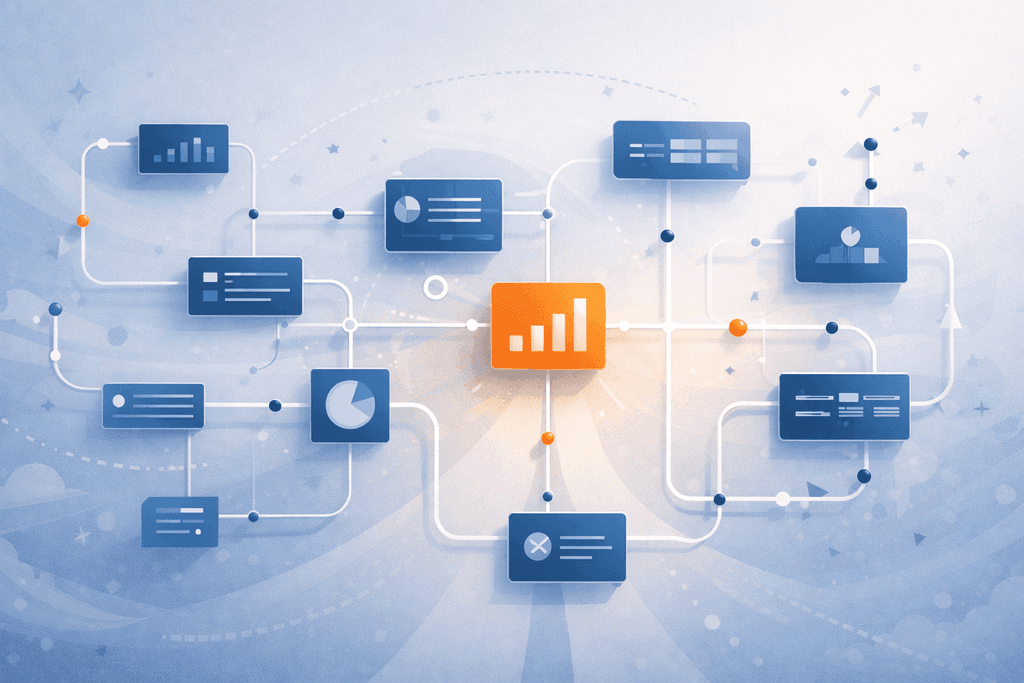
How QPM Helps CEOs: Not “Another Tool,” but a Way to See Execution
Strategy has a weak point: it does not live in a presentation. It lives in teams' daily actions. But a CEO cannot be physically present in every process, every team, and every approval. That is why strong leaders build a system that:
- makes work transparent
- shows what is really happening
- highlights where decisions are stuck
- demonstrates dependencies between teams
- allows leaders to manage focus without micromanagement
This is exactly what tools like QPM are created for. This is especially important in companies with many interdependent processes. Execution often breaks not because someone didn’t do a task, but because one team was waiting for another, and no one could see it. When dependencies are visible, a leader makes stronger decisions. And faster. In this sense, strategic thinking becomes “implemented” — not only in the CEO’s head, but in the system.
Conclusion: In 2026, the Winners Won’t Be the Fastest — but the Clearest
Strategic thinking became the #1 leadership skill in 2026, not because it sounds beautiful, but because reality has changed. Speed has become accessible to almost everyone. Tools, automation, and new technologies all increase the pace. But pace without direction does not make a company stronger.
The strongest companies will be led by those who:
- define the course
- choose focus
- make decisions quickly
- build an execution system
- keep the company on the right track
This is how strategic thinking becomes a competitive advantage.