Predictability Matters More Than Speed: How GameDev Teams Avoid Missing Milestones


In GameDev, there’s an old habit: when a project is “on fire,” the team starts moving faster. More tasks, more meetings, more urgent messages. It feels like a solution, but in reality, it often just accelerates chaos. Today, the reality is even tougher. Game studios operate in a world where budgets are growing, risks are increasing, and tolerance for missed deadlines is shrinking. Publishers, investors, and stakeholders no longer want heroics and last-minute sprints. They want stability and control: predictable workflows, measurable progress, and reliable releases. That’s why delivery predictability now matters more than speed. A fast team that doesn’t know where it will get stuck doesn’t win. The winning team is the one that consistently delivers results.
In this article, we’ll cover:
- why missed milestones in GameDev aren’t exceptions but the natural outcome of chaotic systems;
- what truly destroys deadline predictability;
- which practices help keep delivery under control;
- how producers and leads can build an execution system for GameDev teams.

Why Speed Doesn’t Guarantee Success in Game Development
Speed in game development is tempting. It looks great in presentations and internal chats. But most of the time, it’s superficial. Because speed is just the pace of movement. The real question isn’t how fast you’re moving — it’s where you’re going and what breaks along the way.
Many GameDev studios are now facing three key realities:
- Production complexity has increased.
Teams work across more platforms, integrations, content pipelines, and updates. Even mid-sized games have become complex engineering systems. - Processes are becoming distributed.
Remote and distributed teams are no longer the exception. Coordinating across time zones requires greater discipline, transparency, and clear execution rules. - Live Ops has become the standard.
For many products, release is not the finish line — it’s the beginning of an ongoing cycle. Without a strong execution system, a “successful launch” quickly turns into endless firefighting.
That’s why the answer isn’t speed. The answer is controlled, predictable execution.
Milestones Fail Not Because of Bad Teams, but Because of Weak Management Systems
It’s important to say this clearly: in most cases, GameDev teams don’t miss milestones because they’re lazy or incompetent. Failures happen when the game development management system can’t handle growing complexity.
In GameDev, almost everything is built on dependencies:
- design depends on prototyping;
- art depends on technical constraints;
- code depends on content and technical tasks;
- testing depends on stable builds;
- release depends on many parallel processes.
When dependencies aren’t visible, rhythm breaks down. When progress isn’t visible, decisions come too late. When statuses are updated manually, there’s no single source of truth. That’s why the root cause of missed milestones is the lack of a structured execution system in GameDev.

7 Reasons GameDev Teams Miss Deadlines and Milestones
1) Hidden dependencies between teams
A common scenario: the art team finishes part of the work, but technical integration is delayed. Or developers are waiting for final assets — but it isn’t marked as a blocker. The problem gets noticed too late.
2) Manual status updates
If a producer has to constantly chase updates, the system isn’t working. Statuses should be part of the workflow, not a manual reporting task.
3) No single source of truth
When the plan lives in a spreadsheet, dependencies in a document, tasks in a tracker, and actual progress in chat, the team doesn’t have a process — it has a puzzle. In this setup, milestones become guesswork.
4) Too many parallel priorities
There’s the main development stream, critical bug fixes, content work, technical debt, and marketing requests. Without clear prioritization rules, every new request dilutes delivery.
5) Overly optimistic planning
A “best-case scenario” plan isn’t a real plan. Game development is full of uncertainty, so teams must account for:
- buffers,
- risks,
- assumptions,
- control points.
6) Late escalation of problems
Blockers rarely appear instantly — they build up over time. Without early signals, issues become visible only when it’s already too late.
7) No unified execution logic
When each team works “their own way,” processes stop aligning. Everyone seems busy, but progress slows down.

Delivery Predictability Isn’t Rigidity — It’s Clarity
Delivery predictability isn’t about controlling people. It’s about controlling the system:
- what is being executed right now;
- what is blocking progress;
- who owns the next step;
- how the plan changes when conditions change.
When predictability is high, teams work calmly — without constant firefighting. And leaders make decisions based on facts, not gut feelings.
Which Metrics Help Control Delivery in GameDev
One common mistake is confusing “progress” with “busyness.” Being busy doesn’t mean delivering results.
These are the metrics that actually reflect predictability:
- percentage of milestones delivered on time;
- number of critical blockers per iteration;
- frequency of priority changes;
- average delay in approvals and handoffs;
- visibility of cross-team dependencies;
- number of tasks stuck “in progress” without concrete outcomes.
They allow teams to move from “feeling” progress to actually seeing it.
How Producers Can Build an Execution System in a GameDev Team
Predictability doesn’t come from a single good meeting. It emerges when there is an execution system — structured, transparent, and repeatable.
1) Make progress visible every day
The team should be able to easily answer:
- where are we now?
- what’s completed?
- what’s blocking the next steps?
Not once a week — every day.
2) Treat dependencies as part of the task
A dependency isn’t an agreement in chat. It should be explicitly recorded:
- between tasks;
- between teams;
- with owners and deadlines.
This dramatically reduces “we were waiting on them” situations.
3) Plan with buffers and risks in mind
In GameDev, buffers aren’t “laziness” — they’re the cost of uncertainty.
Every milestone should include:- assumptions;
- risks;
- buffer time for integration, fixes, and testing.
4) Introduce regular execution reviews (production reviews)
A strong practice is a short weekly review focused on:
- upcoming milestones;
- critical tasks;
- risks of delay;
- what needs to change right now.
This isn’t just a status meeting — it’s attention management.
5) Define clear rules for priority changes
When priorities shift chaotically, predictability disappears. The team must know:
- who can change priorities;
- how it impacts milestones;
- what gets removed from the plan when something new is added.
Where QPM Helps: Execution Transparency Without Manual “Syncing”
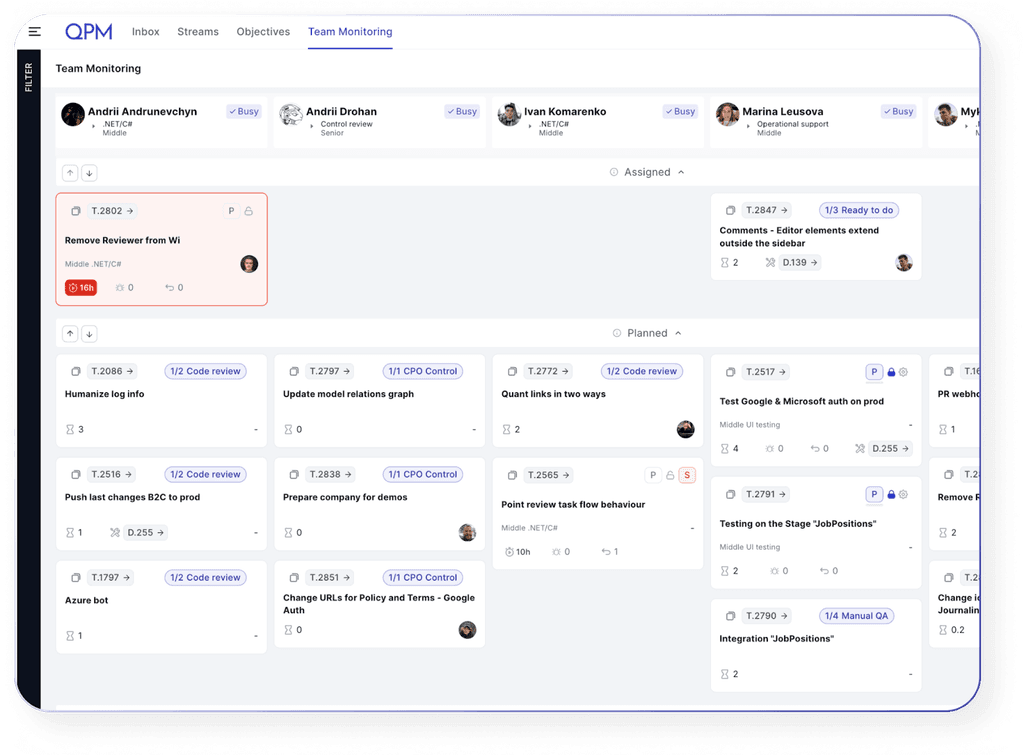
In practice, the most effective approaches don’t just store tasks — they show execution as a system: what’s critical for each milestone, where blockers appear, which dependencies are slowing progress, and how all of this impacts delivery.
Platforms like QPM are built around this exact idea. They help producers and leads see the real state of execution, manage dependencies across Art, Code, and QA, and maintain a single operational context for the entire team — especially in distributed GameDev teams across the US and Europe.
Checklist: How to Avoid Missing Milestones in Game Development
Before starting an iteration or phase:
- all tasks have clear statuses and owners;
- critical dependencies are documented and visible;
- buffers are built in for integration and testing;
- rules for changing priorities are defined;
- risks and escalation criteria are identified;
- the team sees the full picture, not just their individual piece.
If two or three of these points are missing, the milestone is at risk.

When Vacations Derail Milestones: A Typical Production Case
In many GameDev teams, people’s availability still lives “in the manager’s head” or across scattered calendars. Some team members take vacations after releases or during holidays, but this is rarely reflected in the overall production plan.
On paper, milestones look realistic. But when the critical moment arrives, it turns out key specialists are unavailable: developers are on leave, the art lead can’t do reviews, and QA is operating with a reduced team. As a result, the milestone slips not because of task complexity but due to hidden resource constraints.
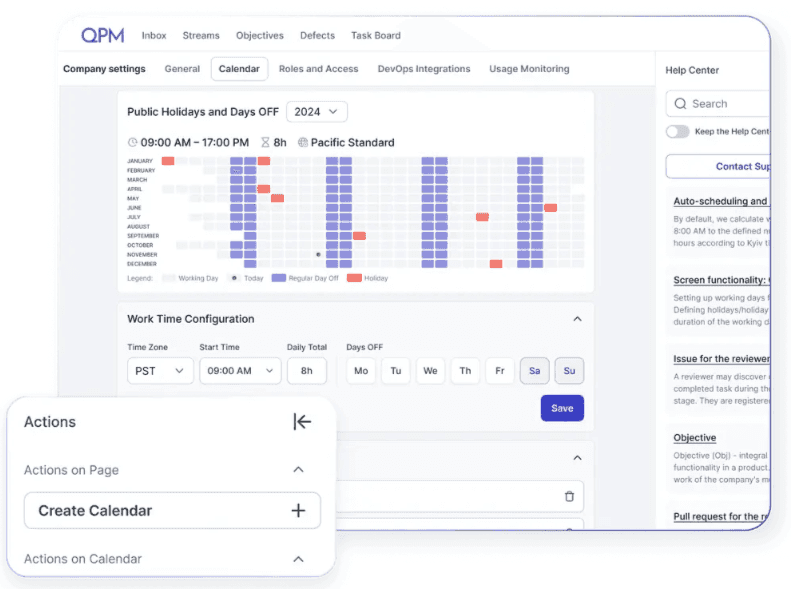
In execution systems like QPM, team availability becomes part of planning through a shared availability calendar. The platform accounts for vacation and parallel project workloads, highlights resource-shortage risks, and allows teams to adjust plans in advance.
This way, milestones no longer depend on a manager’s memory and become truly manageable.
Conclusion: the Most Predictable GameDev Teams Will Win
Game development is no longer a race to be the fastest. It’s a competition to be the most reliable.
Studios that can build predictable delivery gain:
- trust from publishers and stakeholders,
- a calmer, sustainable work rhythm,
- healthier team culture,
- the ability to scale without breaking processes.
Predictability isn’t about working more. It’s about working in a way that makes progress visible and execution controlled.