One Task at a Time: Why It Matters — and How It Works in QPM

The Problem Everyone Sees — and Nobody Solves with Tooling
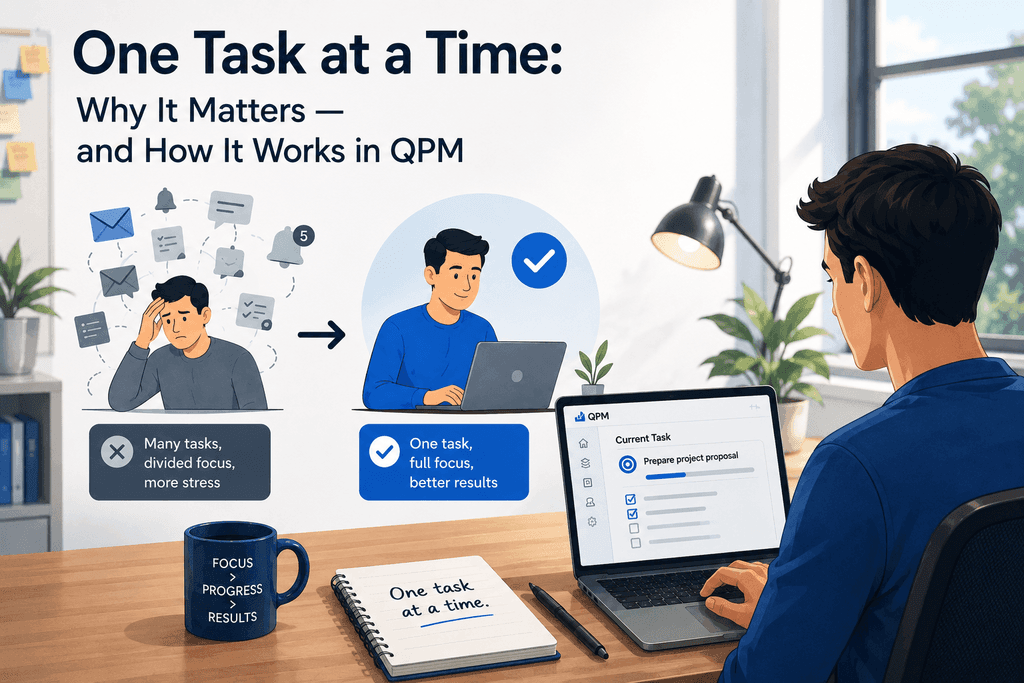
Open any sprint board in a mid-sized IT team or game studio. Find any developer or artist. Look at how many tasks are assigned to them at once. Five. Eight. Sometimes twelve.
Formally — everything is under control. Tasks are distributed, assignees are set, statuses are filled in. But ask the person themselves, and they'll tell you: "I don't know where to start. Everything is urgent. Everything is important. I switch between tasks several times a day and never finish any of them properly."
This is not a discipline problem. It's a planning system problem — one that assigns tasks in bulk and puts the responsibility for prioritization on the person.
What Happens to the Brain When Switching Tasks
Cognitive psychology research has documented this for decades: switching between tasks is not free. Every time a person interrupts one piece of work and picks up another, the brain needs time to reorient — load a new context, remember where it left off, figure out what to do next.
This period is called "switching cost" — and the numbers here are specific.
Research by Gloria Mark et al. (2008) showed that after an interruption, a person needs an average of more than 23 minutes to restore focus — with levels of stress and time pressure rising in the process. Research by Parnin & Rugaber (2010), focused specifically on developers, confirmed that programmers experience serious difficulties recovering context after interruptions — they have to rebuild the mental model of the code, variable states, and the logic they were working through.
For a developer writing complex code, this is critical. Entering a state of deep concentration — what is commonly called flow — takes 20–30 minutes. One interruption resets that counter to zero.
For a 3D artist working on a detailed asset, switching means losing visual context and needing to "see the material fresh" again.
For a QA engineer running a test session — losing the chain of bug reproduction.
The scale of the problem is larger than it appears. Research finds that chronic task-switching consumes up to 40% of productive time. In an eight-hour workday, that means the real focused output is around 4.8 hours — the rest goes to the cognitive cost of reorienting between tasks. Multiply that by eight tasks running in parallel — and you get a team that is formally busy but producing significantly less than it could.

Why Standard PM Tools Make the Problem Worse
Jira, Linear, ClickUp — all of them allow you to assign any number of tasks to a person simultaneously. This isn't a bug, it's an architectural decision: the tools are built for the manager to see the full picture of assignments. What happens to the person underneath that picture — the tool doesn't track.
The result is a familiar situation: The manager sees: "Ivanov is assigned to 6 tasks, all In Progress." Ivanov sees: "I have 6 tasks, all urgent, I don't know where to start." The system shows load. It doesn't show focus.
And nobody is accountable for the fact that the person switches between tasks 15 times a day — because the system allows it and does nothing to limit it.

What Happens to a Person When There Are Too Many Tasks
This isn't just a productivity question. It's a psychology question.
When a person opens their task list and sees eight items — all assigned to them, all with status "in progress," all with deadline "urgent" — a well-studied mechanism fires in the brain. Cognitive Load Theory, developed by psychologist John Sweller in the 1980s, explains it: working memory has a strictly limited resource. When incoming information exceeds that resource, cognitive overload sets in.
In a state of overload, a person behaves predictably — and not at all the way the manager expects. Instead of methodically closing tasks one by one, they start chaotically switching between them in search of the one that feels "easier to start." Often the simplest and least important task gets chosen — just to feel some sense of progress. This isn't laziness or incompetence. It's the brain's normal response to the pressure of unmet commitments: an overloaded person gravitates toward easy, often low-value tasks to preserve the feeling of productivity — or becomes paralyzed and doesn't know where to begin at all.
There's another psychological effect that rarely comes up in discussions of task management: the Zeigarnik Effect. Unfinished tasks continue to occupy working memory — the brain keeps them "open," constantly returning to them as background thoughts. The more unresolved tasks a person is carrying, the more cognitive resource goes simply to "holding" them — and the less is left for actual work on the current task.
The result: a person with eight tasks running in parallel isn't doing eight tasks simultaneously. They're not doing any of them — truly. Each gets fragmented attention, each moves slowly, each carries the risk of error from insufficient focus.
Modern research in organizational psychology increasingly frames cognitive overload not as an individual employee problem, but as a risk of work system design. In other words: if your planning system allows ten tasks to be assigned to one person at once — the problem is not with the person.

The Single-Task Principle: What It Delivers in Practice
When a person works on one task at a time, several things change.
Execution speed increases. Without switching, a person finishes the task faster — not because they work more intensely, but because they don't lose context and don't spend time "warming back up" after each interruption.
Quality increases. Deep concentration on a single task allows noticing details that get lost in a shallow multitasking mode. This is especially critical for technical work where the cost of error is high.
Stress decreases. One of the main drivers of professional burnout is the constant feeling of falling behind. When a person has one active task, that feeling disappears. They know exactly what to do right now.
Planning predictability increases. If every person on the team is working on one task, the manager can actually forecast when it will be done. With eight tasks running in parallel, that forecast becomes a guess.

How This Works in QPM
Most PM tools leave the question of focus to the discretion of the individual or their manager. In qpm.ai, it's resolved at the level of system logic.
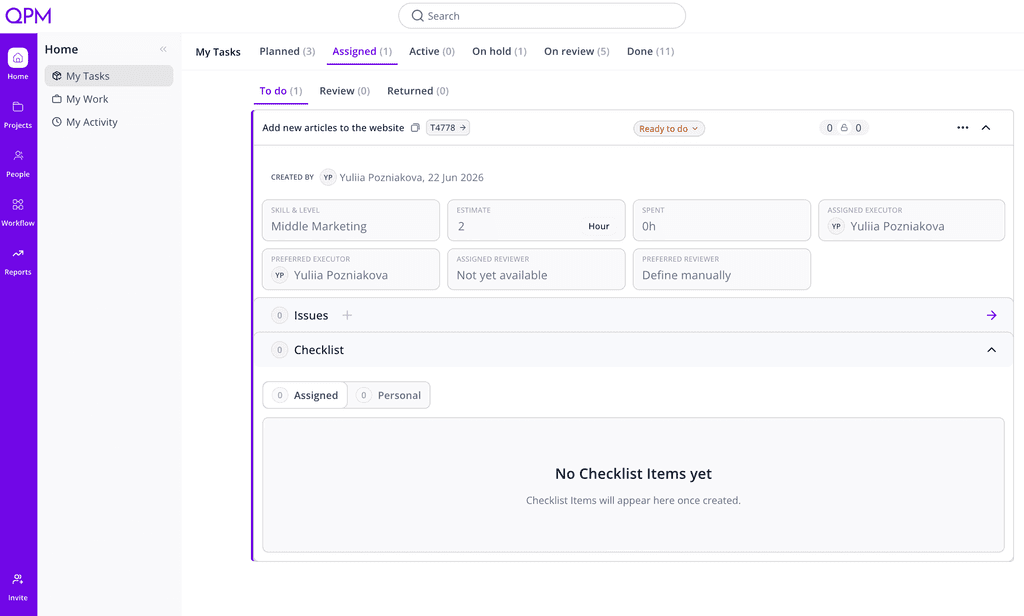
Tasks are assigned gradually. The system doesn't dump the full iteration task list on a person at once. A new task appears for the assignee only after the previous one is closed. The person doesn't see a queue of ten items — they see one specific task that needs to be done now.
One hold. Sometimes a task needs to be temporarily paused — for personal reasons, due to a priority shift, or because something urgent comes up. In qpm.ai, a person can put no more than one task on hold at a time. This isn't a restriction for its own sake — it's protection against the situation where "temporarily" turns into a permanent parallel-work mode.
Blocker — a separate tool. If a task can't continue due to an external reason — a needed asset is missing, a response from another team hasn't come, a dependency has been discovered — the person creates a blocker. This records the reason for the stop and makes it visible to the manager. A blocker is not "I paused the task" — it's "the task is stopped due to reason X, which needs to be resolved."
The difference between a hold and a blocker is fundamental: a hold is the assignee's decision, a blocker is a signal to the system and the team.
The result. A person in qpm.ai is always in one of three states: working on a task, has one task on hold, or has filed a blocker. No ambiguity. No "I have eight tasks and I don't know what to grab first."
Summary
The "one task at a time" principle is not a methodological recommendation. It's an operational decision that directly affects delivery speed, work quality, and stress levels across the team.
Most PM tools ignore this principle — because their architecture is optimized for manager visibility, not for the assignee's focus.
In qpm.ai, it's built into the system logic: gradual task assignment, one hold, blocker as a dedicated signaling tool. A person always knows what to do right now — and never ends up in a situation where ten tasks are assigned to them and all of them are urgent.