Maximizing Team Efficiency: How QPM Reduces Time-to-Market


In modern development, the speed at which a product reaches the market is a key factor in competitiveness. The faster a team can build, test, and release a product, the greater the chances of securing its place in the market. That’s why Time-to-Market (TTM) has become one of the main KPIs for technology companies, startups, and game development studios. However, in practice, the problem is rarely that people are not working hard enough. More often, the real issue lies elsewhere — in chaotic processes, constant task switching, and the lack of a clear system for managing work. These factors slow teams down far more than technical challenges do.
Why Teams Actually Work Slower Than They Could
Research in productivity psychology reveals an interesting pattern. The brain spends a significant amount of time “loading” the rules and context for each new task. According to research by the American Psychological Association (APA), without clear planning, a team can spend up to half of its working time simply figuring out, “What should we do next?” This shows up in familiar situations:
- when a developer has several tasks at the same time, returning to any of them requires time to restore the context
- a designer switches between revisions and new assignments
- the team spends time clarifying details in chats
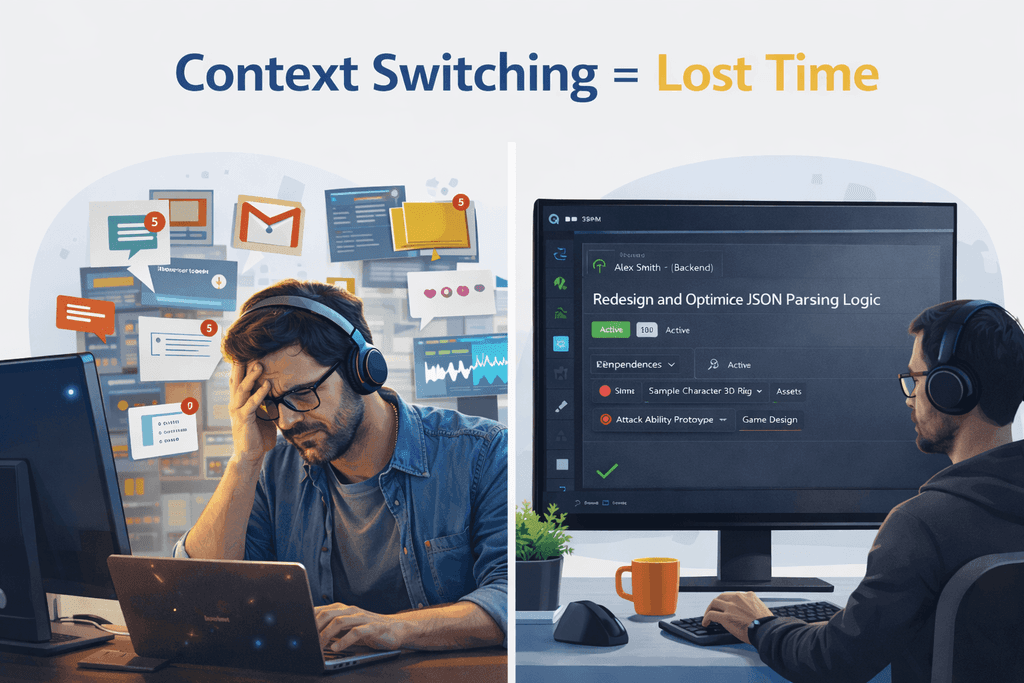
Another major issue is context switching — moving between different tasks. When a person switches from Task A to Task B, part of their attention remains “stuck” on the previous task. This phenomenon is called attention residue. It creates cognitive friction, significantly slowing down work. As a result, the team may appear busy, but progress moves much more slowly than expected.
How QPM Minimizes Loss of Focus
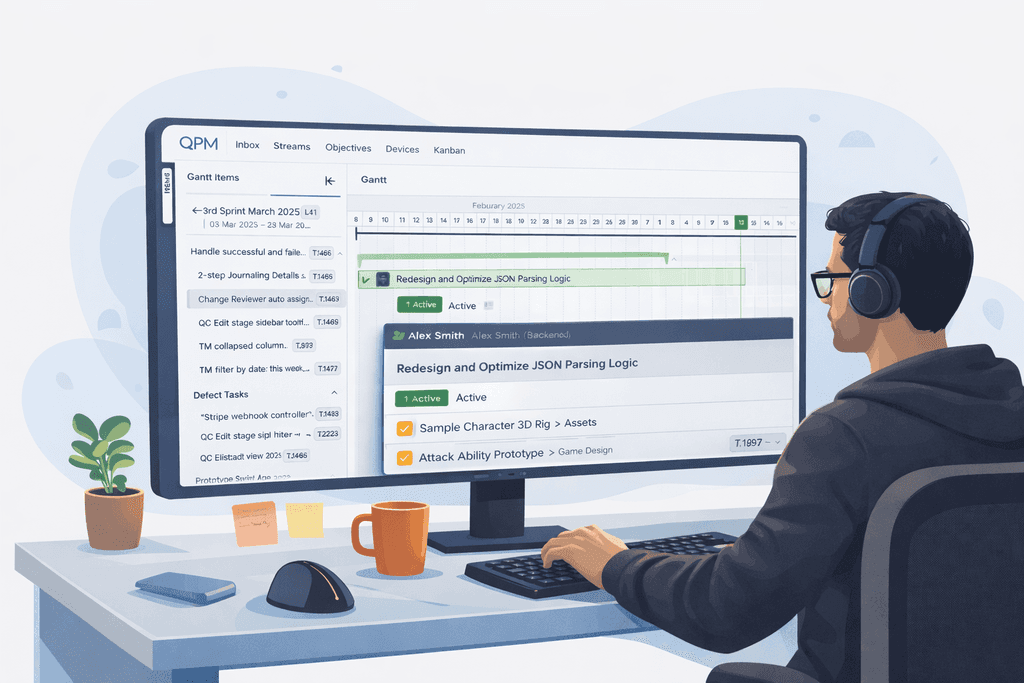
QPM creates an environment where teams can work in Deep Work mode — with full concentration and minimal distractions. The system enforces a disciplined workflow:
- one active task
- one priority
- one focus
Chaos ensues when a developer has five tasks in the “Active” status at the same time, yet none of them move forward. QPM eliminates this problem. When a person works on a single task, they no longer need to constantly switch contexts. And when they return to a previous task, they don’t have to rebuild the context from scratch. Every task switch means lost time and lost money.
Transparency Instead of Micromanagement
One of the main reasons projects get delayed is the lack of an objective view of the process. Managers are forced to constantly ask:
- “What’s the status of this task?”
- “Why isn’t it finished yet?”
- “What stage is the work at?”
This leads to micromanagement and unnecessary communication. QPM solves this problem through full process transparency. The system automatically shows:
- active tasks
- the pace of work
- potential risks
- blocking points
When the process becomes visible, chaos begins to disappear on its own.
An Objective Mirror of Team Performance
You cannot force everyone to be responsible. But you can create a system where the absence of work cannot be hidden. QPM builds a culture of transparency without unnecessary conversations. Unlike traditional time trackers that people can simply turn on and forget, the system measures real active time spent working on a task. This is not control for the sake of control. It becomes the foundation for:
- fair compensation
- accurate planning
- reliable deadline forecasting
As a result, the working day is no longer an abstract eight hours. Instead, it becomes a clear amount of real focused work time.
What Makes QPM Different from Traditional Project Management Systems
Most project management systems are essentially digital notebooks. People write down what they want to write. But these systems rarely show what is actually happening with the work. QPM takes a different approach. It is an operating system for managing work. We don’t just track tasks. We reveal:
- the real pace of work
- process bottlenecks
- dependencies between teams
- potential delay risks
The system does not allow tasks to remain in Active status without real activity. As soon as the pace of work drops, it becomes visible.
How QPM Reduces Time-to-Market
In traditional systems, developers often add an extra 30% of time to account for unexpected issues. This happens because the process is difficult to predict. With QPM, teams work with pure focus time. The system allows teams to:
- see the real pace of work
- detect process slowdowns
- respond to risks in real time
As a result, Time-to-Market can be reduced by 20–30%. And this doesn’t happen because people work more. It happens because artificial delays are eliminated. Instead of waiting until the end of the sprint to discover a problem, teams can see deviations in real time.
Case Study: How Task Switching and Lack of Transparency Slowed Down the Product Launch
One of the product teams we worked with was developing a new analytics module for their SaaS platform. The team consisted of three developers, one designer, and a product manager. At first glance, the process looked fine: tasks were documented, sprints were planned, and the team held regular stand-ups. However, the module’s release kept getting postponed. After analyzing the process, it became clear that the main issues were twofold: constant task switching and a lack of transparency into the workflow.
Each developer had 4–5 active tasks at the same time:
- bug fixes
- new features
- technical debt
- urgent changes from the product team
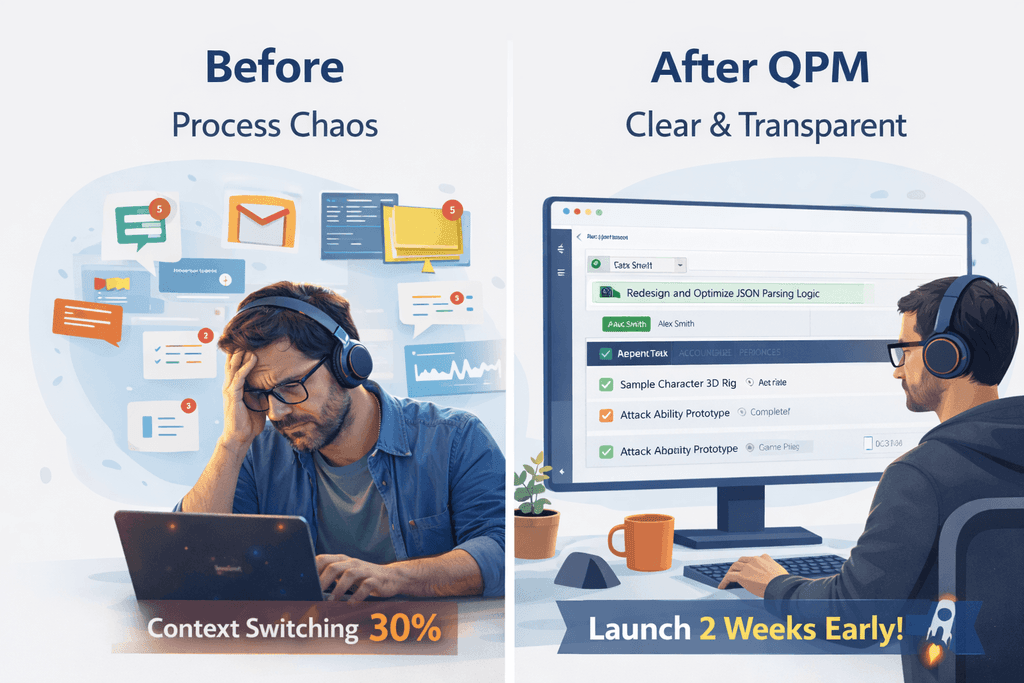
As a result, the workflow often looked like this: a developer starts working on a new feature → receives a message about a bug → switches to fixing it → returns to the feature and spends time restoring the context. Meanwhile, managers were trying to understand the project's true status through questions during meetings and in chats. As a result, the team spent significant time not only switching between tasks but also explaining the status of the work. According to the team’s estimates, up to 30% of their time was lost due to task switching and context restoration, while delay risks often became visible too late.
What Changed After Switching to QPM
After implementing QPM, the team moved to a new working model:
- one active task per team member
- clearly defined work priorities
- full transparency of task status for the entire team
The system began to automatically show:
- active tasks
- work pace
- process blockers
- deviations from the planned pace
As a result, managers no longer needed to constantly ask about the status of tasks — the entire workflow became visible in real time. If a task remained in Active status for too long, it became immediately apparent, allowing the team to quickly identify the cause of the delay.
As a result:
- the pace of task completion became predictable
- stuck tasks disappeared
- communication in chats decreased
- the team finished the module two weeks ahead of schedule
Most importantly, the team stopped spending energy constantly explaining the process. Instead, all attention was focused on real progress in the work.
Conclusion
Reducing Time-to-Market is not only about employee speed. It is a matter of process structure. When work is chaotic, even the most talented team works slowly. QPM creates a system where processes are transparent, focus is preserved, risks are visible in advance, and dependencies are manageable. And instead of spending time solving organizational issues, the team can focus on the main thing — working efficiently.