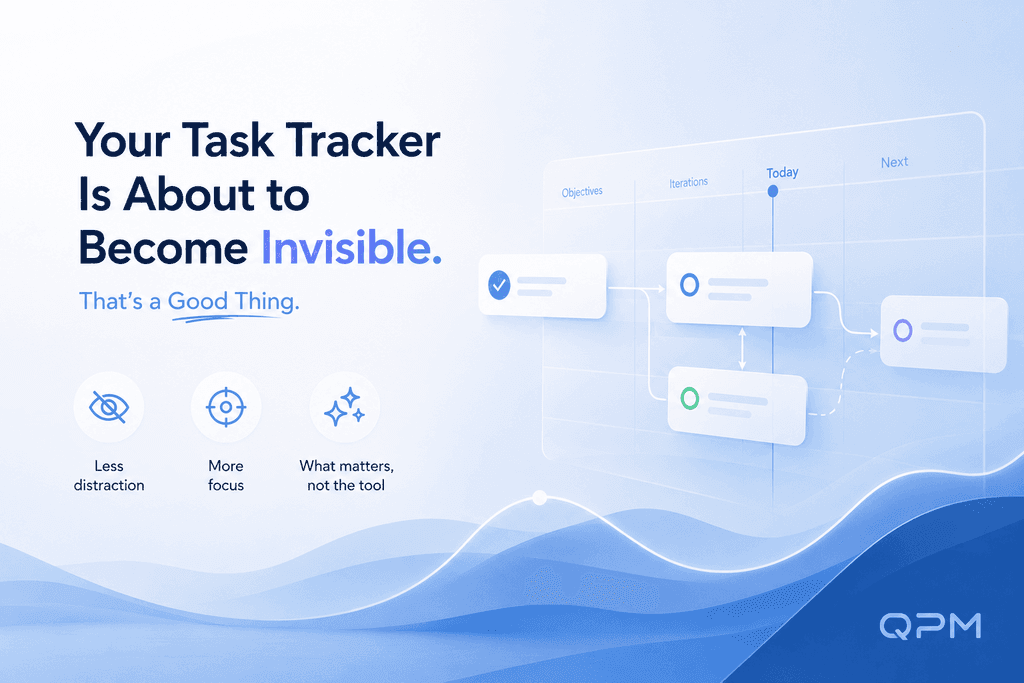
Your Task Tracker Is About to Become Invisible. That's a Good Thing

The real cost of "just update your status"
A developer is in flow. They're holding a feature's architecture, three dependencies, and one nasty edge case in their head. Then: "Hey, can you update the tracker and drop a comment?"
According to Atlassian's State of Developer Experience 2025 report, developers spend just 16% of their working time actually writing code. The rest goes to coordination, hunting for information, and reporting. Multiply that by the size of your team — and you get an invisible tax your studio pays daily. Not for the work. For servicing the work.
For years this was treated as unavoidable: a tracker is a place you have to "go to." In 2026, that's no longer true.

What MCP is and why everyone's talking about it
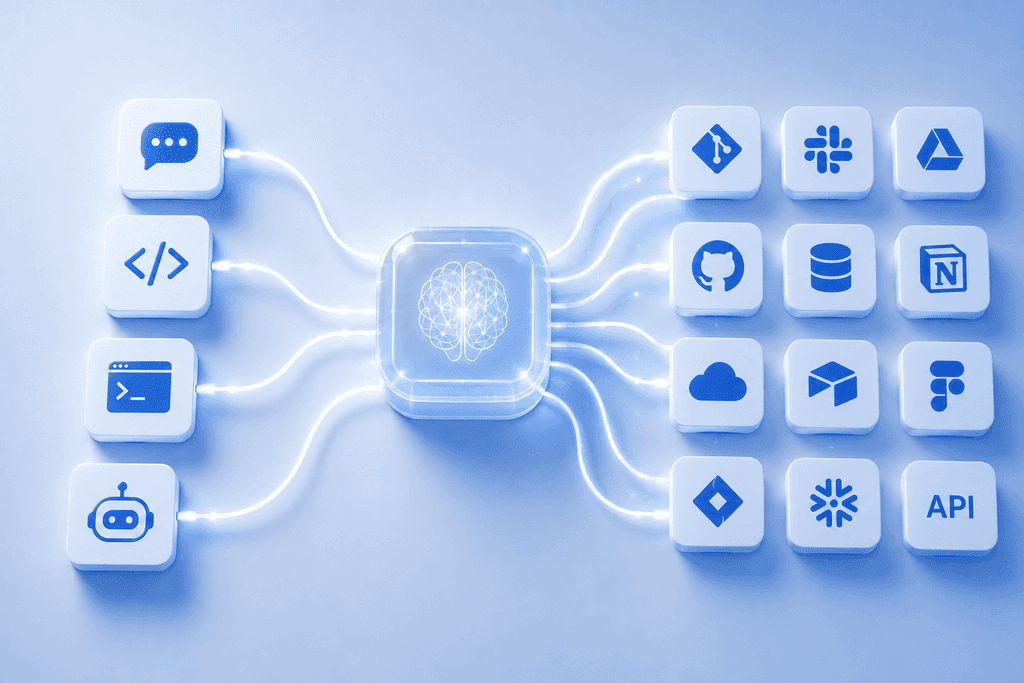
Model Context Protocol (MCP) is an open standard introduced by Anthropic in late 2024. The best metaphor going: "USB-C for AI" — one universal connector that lets any AI assistant plug into any tool. No custom integration for every model-plus-service pair.
The math is simple and brutal: 10 AI tools and 100 services without a standard means up to 1,000 separate integrations someone has to build and maintain. With MCP — 110: every tool and every service implements the protocol once.
The numbers show this is infrastructure, not hype:
- The protocol's official SDKs are downloaded 97 million times a month — up from 100,000 at launch. For scale: React took three years to reach that volume; MCP did it in 16 months.
- The standard is backed by OpenAI, Google, Microsoft, IBM, and Amazon.
- The official registry lists nearly 10,000 public MCP servers.
- Roughly 28% of Fortune 500 companies have already put MCP into production workflows.
What does that mean in practice? Your AI assistant — in your IDE, terminal, or chat — can work directly with your tools. Not through copy-paste. Through a protocol.
A tracker you never have to visit
Here's where project management changes.
The classic model: your PM system is a separate world. A developer leaves their environment, logs in, finds the task, updates the fields, comes back. Every step is friction. Friction compounds — and statuses start lagging behind reality. The PM chases people for updates. Everyone's annoyed.
Attention research by Gloria Mark at UC Irvine shows just how expensive this is. After an interruption, people rarely return to the task directly: on average they complete two other tasks first before finding their way back. Average uninterrupted attention on a single screen has collapsed from 2.5 minutes in 2004 to 47 seconds today. And interrupted tasks contain twice as many errors. So "go update the tracker" doesn't cost a minute — it costs the flow state. And it hits not just speed, but code quality.
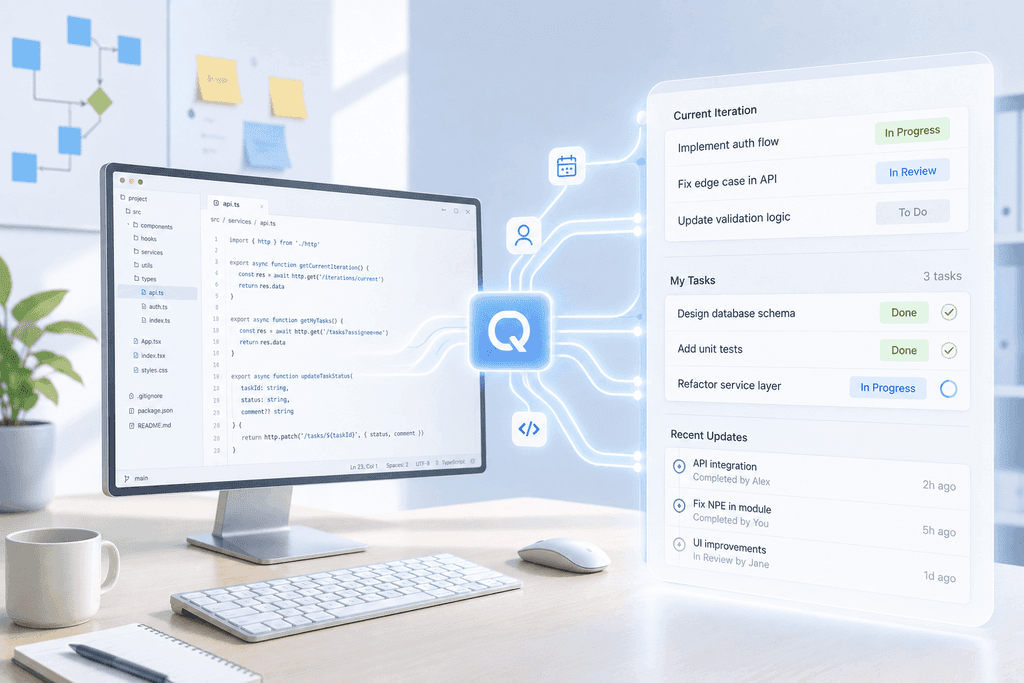
The MCP model: your PM system becomes a service that answers requests right inside the developer's environment. "What's on my plate this iteration?" — answered in the same window where they write code. A status updates not because someone remembered at the end of the day, but as a side effect of doing the work.
The difference is fundamental. In the first model, data freshness depends on discipline. In the second, it depends on architecture.
How this works in QPM
At QPM, we're moving platform interactions to MCP — and part of it is already in production. A developer connects QPM as an MCP server to their AI assistant and works with tasks without ever leaving their own environment. No tabs, no switching, no "I'll update the tracker later."
This isn't a one-off experiment — it's a systematic direction. Over the coming months we'll be shipping new MCP capabilities in regular updates, from day-to-day task operations to deeper project analytics. Each release will get its own announcement.
What the PM gets out of it
MCP looks like a developer story. The biggest winner is actually the manager.
QPM calculates timelines deterministically: Autoplanning and the Iteration Test account for vacations, workloads, and skill bottlenecks through the Skill Graph. But any calculation is only as accurate as the data underneath it.
When status updates are built into the developer's workflow instead of hanging on their memory, you get the thing that matters most: a plan computed from reality, not from yesterday's statuses. The Iteration Test shows an honest milestone date because the system knows what's actually happening — no morning stand-up interrogations, no evening reminder pings.
The developer gets uninterrupted flow. The PM gets a live picture without micromanagement. It's a rare case where both sides win at once.