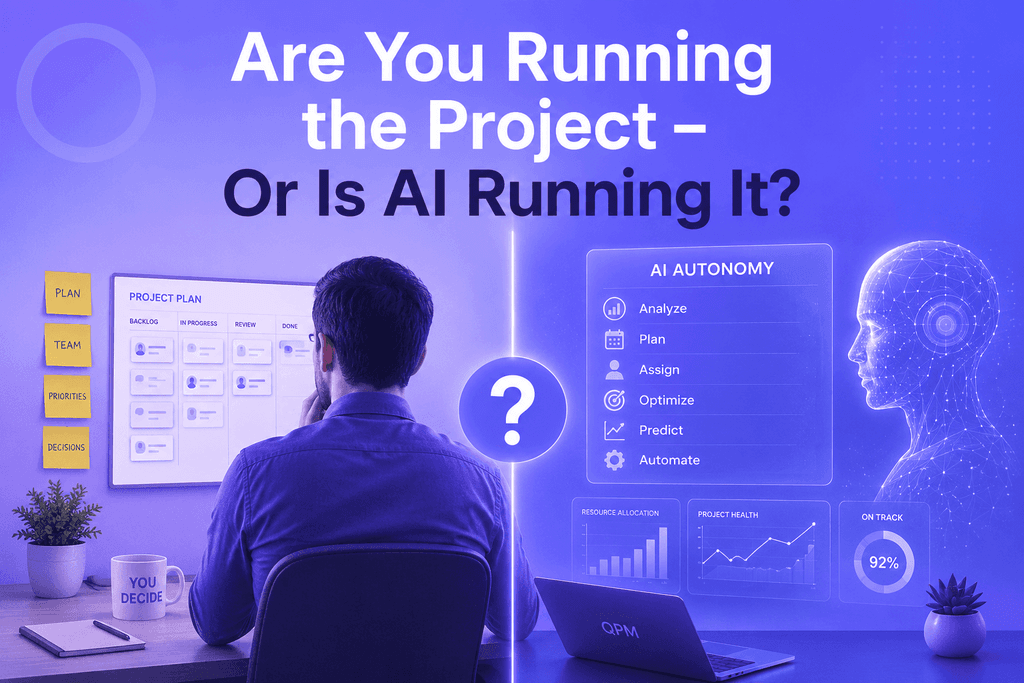
Are You Running the Project – Or Is AI Running It?

Over the past few months, we've broken down QPM in detailed comparisons against Jira, ClickUp, Monday, Asana, Float, and Runn – all comparisons here. One thread runs through every single one of them: almost all these tools are now adding an AI layer on top – suggestions, automatic priorities, "smart" recommendations. QPM doesn't. And that's a deliberate choice.
AI is everywhere right now – and that's fine
2026 is the year an AI assistant shows up in almost every PM tool. ClickUp has Brain and AI-based auto-assignment. Asana is adding AI agents into workflows. Even Jira is pulling AI suggestions into Atlassian Intelligence. That's real value – AI is good at guessing, good at suggesting, good at summarizing.
But there's a difference between "guessing" and "calculating."
QPM calculates. It doesn't advise.
QPM's core logic – Autoplanning, Autoassignment, Iteration Test – is a deterministic calculation, not a probabilistic model. When QPM says a feature will ship on November 14th, that's not a forecast based on similar projects from the past. It's the result of a calculation: who's available with which skill, how long the QC iteration will take, who's on vacation, where the bottleneck sits on the Skill Graph. Change the input, and the date changes. No "roughly," no "the AI thinks so."
This isn't just a different logic – it's a different kind of accountability. A deterministic calculation can be verified: the same input always produces the same output, and any date can be explained to a client or manager step by step. You can't verify an AI suggestion the same way – it either shows up or it doesn't, and the "why this one" question goes straight to a black box.

What happens if the AI goes down
Here's a practical question rarely asked out loud: what if the AI layer in your PM tool suddenly stops working? A data center overheating, an API provider outage, any reason at all – the cause doesn't matter. What matters is this: in most tools, AI isn't an add-on feature anymore – it's part of how decisions get made about priorities, deadlines, task assignments. If that layer goes down, your planning goes down with it.
In QPM, that situation doesn't exist. Autoplanning and Iteration Test are a deterministic algorithm, not a call to an external LLM. It calculates dates the same way today as it would if the AI provider were unavailable for an hour, a day, or a week.
Worse than an outage – a silent mistake
But a shutdown isn't the worst-case scenario. The worst case is when AI doesn't fail – it quietly gets it wrong. A probabilistic model might miss a vacation entry added an hour ago, mix up the priority of two tasks, or "decide" a backend developer is a fit for a QA task because they did something similar once. The system still looks like it's working – it calculated something and produced a date. Nobody notices until the deadline has already slipped by.
No AI system – including the ones we use ourselves inside QPM – works perfectly or is immune to this. This isn't a criticism of any specific product; it's a property of the approach itself: a probabilistic model will, by definition, sometimes be wrong, and the real problem is that you won't always know when. A deterministic engine doesn't fail that way – it either calculates from the formula with all the inputs it has, or it immediately surfaces an input error. There's no in-between "mostly right."

Who's actually running the project
Which brings up the real question worth asking when choosing a PM tool: are you running the project – or is AI running you? If deadlines, priorities, and task assignments are being decided by an algorithm whose logic you can't see and can't reproduce by hand, then control over the project has already partly shifted – from you to the model and its provider.
This isn't "AI is bad" – it's about reliability and control
We use AI actively inside QPM ourselves, wherever it genuinely helps – it simplifies routine work and speeds things up, for example in generating contribution summaries for each team member. AI is genuinely useful, and there's no reason to give it up.
But relying only on AI for what determines your actual deadlines is risky in two ways: dependency on someone else's infrastructure, and a loss of control over the logic behind the decisions. It's like keeping all your money on a card: convenient, as long as everything works. But no banking system offers a 100% uptime guarantee – which is why it's always worth keeping some cash "just in case." QPM is that cash reserve for your planning: the core calculates on its own, transparently, independent of whether the AI model happens to be up right now.