AI Assistants, Agents, AI PM: What Changed in 2026 and What It Means for Teams

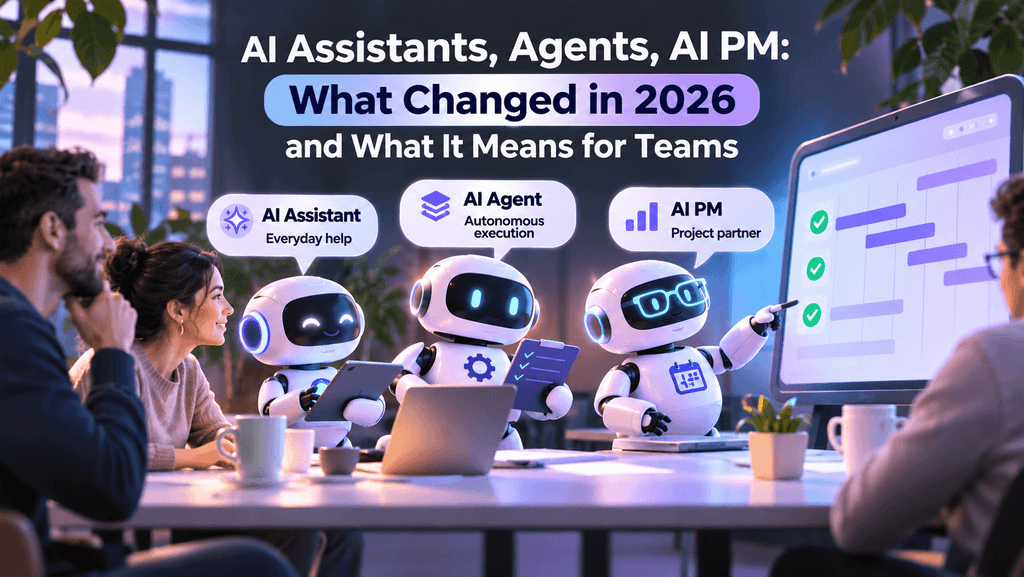
Just two years ago, AI in work tools was mostly a chat window where you could ask a question. In 2026, most companies are no longer asking whether to use AI agents. They’re deciding how to build them into daily work. Here’s what changed, how an assistant differs from an agent and a virtual project manager, and where teams most often go wrong during adoption.
What changed in two years
In short: AI agents moved from pilots into daily work, and faster than even analysts expected.
Companies. According to KPMG’s AI Pulse survey (Q1 2026), 54% of organizations are actively deploying AI agents in core processes. Two years ago the figure was 11%; in mid-2024 it was 33%.
Software. Gartner forecasts that by the end of 2026, 40% of enterprise applications will include task-specific AI agents, up from less than 5% in 2025.
Market. Analyst firms estimate the AI agent market at $7.6–8.3 billion in 2025 and $10.9–12.1 billion in 2026, with projected growth of 43–50% per year.
Project management. According to research by the UK’s Association for Project Management (APM), 71% of professionals already use AI in their projects, nearly double the share two years ago.
The nature of the doubts has changed too. In 2025, the main barrier to AI in project management was resistance to change. In 2026, the top barrier is not knowing how to apply it, cited by about a third of respondents. In other words, people are no longer rejecting AI. They just don’t always know how to fit it into their work.

Assistant, agent, AI PM: what’s the difference
Gartner describes this as a sequence of stages: first, assistants embedded in every application; then task-specific agents; and by 2029, systems of multiple agents working together. For a team, the difference is practical: who sets the task and who is responsible for the result.
An assistant helps one person work faster. An AI PM helps the whole team keep track of agreements and see tasks through to results.
Why project management is one of the first areas for agents
Project management consists of repetitive actions that take time but rarely require unique decisions. This is exactly the kind of work handed to agents first.
Turning agreements into tasks. After a meeting, someone has to write down who does what and by when. It’s routine work that often gets postponed or done incompletely.
Tracking deadlines. Checking statuses, sending reminders, noticing when a task has stalled — daily work that doesn’t need a dedicated person.
Reporting. Pulling together what was done during the week and preparing a short summary.
Checking results. Comparing completed work against the criteria agreed at the start.
This is especially noticeable in small and mid-sized teams. A dedicated project manager often doesn’t fit the budget, so the role gets split between the founder, a department head, or “whoever is most organized.” An AI PM makes it possible to hand off part of that work without hiring someone new.

Where adoption breaks down
The rapid spread of agents has a downside. According to Liferay, 54% of companies have already launched AI agents, but only 25% measure their impact. Gartner estimates that more than 40% of agent projects are at risk of being cancelled by 2027 — most often because of poorly defined tasks and lack of oversight, not the technology itself.
In practice, it looks like this:
Agents aren’t given clear tasks. Without a clear outcome and deadline, AI does “something useful,” but it’s hard to evaluate.
There are no completion criteria. A task gets marked as done, but no one checks whether it was actually done as agreed.
AI lives separately from the work. The team talks to a chatbot in one window while tasks are tracked in another. Results have to be moved over manually, and some get lost.
The takeaway is simple: AI delivers results where it’s built into the process, from setting the task to checking the outcome.

What it looks like in practice: QPM Solutions
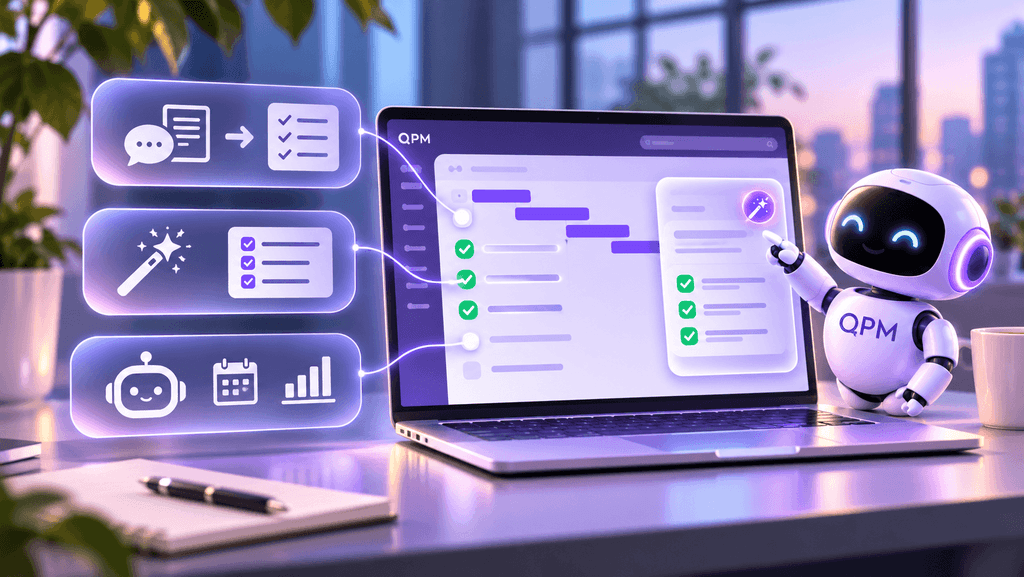
In QPM Solutions, AI is built into every step of working with tasks rather than placed in a separate window. It works on three levels.
1. AI assistant: from words to tasks. Describe a task in your own words or paste meeting minutes or a transcript. The assistant breaks it down into tasks with assignees, deadlines and completion criteria.
2. A “magic wand” next to every field. Task description, criteria, checkpoints — in any field, you can ask AI to help phrase, expand or structure the content. For example, for a “Competitor analysis” task, AI will suggest a checklist:
- Identify 5–7 main competitors
- Collect prices and plans
- Compare positioning and key messages
- Prepare conclusions for the team
3. QPM AI PM: a virtual project manager. You can assign it work just as you would a colleague: break a project into stages, track deadlines, remind assignees, prepare reports. Before a task is closed, the AI PM checks it against the agreed criteria. That way, “Done” means the work has actually been done.
The platform suits different teams — marketing, sales, operations, IT. Setup for a team’s processes takes 2–3 days. QPM Solutions is currently available in free early access.
Where a team should start
You don’t have to start with a large rollout. One process that currently takes the most time is enough.
Pick one routine. For example, writing up tasks after meetings or the weekly report.
Agree on completion criteria. What exactly must be done for a task to be closed.
Keep AI where tasks live. That way, its output doesn’t have to be moved over manually.
Leave decisions to people. AI prepares, reminds and checks, but priorities and the final say belong to the team.
Review the results after a month. How many tasks were closed on time, how many were sent back for rework, how much time was freed up.
You can see how it works in QPM Solutions — early access is free.